Harmless vs Serious Squeaking
The first step is to establish whether what you are hearing is a cause for concern or a normal characteristic of your brakes in Kenya's conditions. These patterns will help you decide how urgently to act.
| Squeak Pattern | Likely Cause | Action |
|---|---|---|
| Only on first 2–3 stops of the morning, then stops | Surface rust on discs — normal in Kenya's humidity | Normal — no action needed |
| Only after overnight rain, clears after a few stops | Moisture on disc surface | Normal — no action needed |
| Squeal every time you brake, all day | Worn pad wear indicators or glazed pads | Book inspection this week |
| High-pitched squeal under light braking only | Pad vibration or glazing | Have brakes inspected |
| Grinding or metal-on-metal sound | Pads worn through — metal contact | Stop driving — repair today |
| Squeaking with pulling to one side | Uneven pad wear or seized caliper | Inspect immediately |
7 Common Causes in Kenya
1. Surface Rust on Brake Discs (Normal)
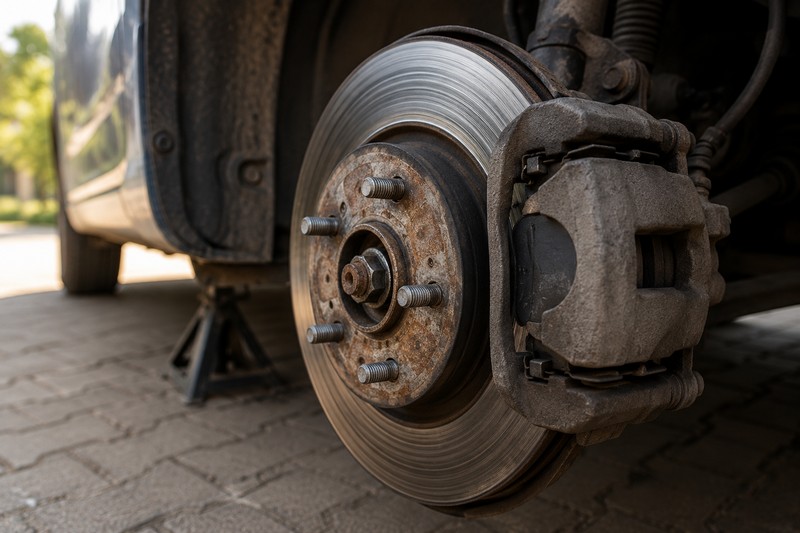
Kenya's humidity — particularly during the long rains from April to June and the short rains in October and November — causes a thin layer of surface rust to form on brake discs overnight whenever the car is parked. This is entirely normal and happens to every car with iron brake discs. When you first drive the car and apply the brakes, the pads scrape this rust layer off the disc surface, producing a brief squeaking or scraping sound that disappears completely after two or three stops.
This type of squeaking requires no action. It is more noticeable in Nairobi's wetter months and after the car has been parked for several days. If the noise disappears fully after the first few brake applications each morning, you have nothing to worry about.
2. Worn Brake Pad Wear Indicators
Most modern brake pads have a small metal wear indicator tab built into the pad. When the friction material wears down to the minimum safe thickness, this metal tab contacts the brake disc and produces a deliberate high-pitched squealing sound — a designed warning that the pads are due for replacement. This is the most important squeaking noise to recognise in Kenya because it means your brakes need attention within the next few hundred kilometres.
The wear indicator squeal is typically continuous during braking, present in all driving conditions (not just mornings), and does not go away after a few stops. It may be accompanied by slightly reduced braking effectiveness. Brake pad replacement at this stage costs Ksh 3,000–10,000 per axle and is straightforward. Delay beyond this point and the metal backing plate contacts the disc directly — a grinding sound, destroyed discs and a significantly larger bill. Find a brake specialist near you.
On many cars you can see the brake pads through the wheel spokes without removing the wheel. The pad friction material is the darker coloured layer pressed against the silver disc. If the pad looks very thin — less than 3–4mm — or you can barely see any friction material, replacement is due. A visual check takes 30 seconds per wheel.
3. Glazed Brake Pads or Discs
Glazing happens when brake pads or discs are overheated, causing the surface to harden and become smooth and shiny. When glazed surfaces contact each other during braking, they produce a high-pitched squeal — sometimes more like a squeak — particularly under light braking. Glazing is common in Kenya because of the long descents on the escarpment road and on routes like Nairobi–Nakuru, where drivers ride their brakes continuously rather than using engine braking.
Glazed pads also have significantly reduced braking effectiveness — the car takes longer to stop than it should. Lightly glazed discs can sometimes be cleaned up by a mechanic with abrasive paper. Glazed pads typically need replacement (Ksh 3,000–10,000 per axle) because the hardened surface cannot be restored to its correct friction coefficient.
4. Dust and Debris Between Pad and Disc
Kenya's murram roads and dusty conditions deposit fine grit, sand and debris onto brake components. A piece of road grit or a small stone trapped between the brake pad and disc produces a persistent scraping or squeaking sound that can appear and disappear unpredictably. This is more common after driving on unpaved roads in areas like Ngong, Kitengela, or upcountry routes.
In many cases the debris works its way out on its own after a few brake applications. If the sound persists for more than a day, have the brakes inspected — the debris may be scoring the disc surface or embedded in the pad. A brake inspection and cleaning costs Ksh 500–1,500 at most Nairobi garages.
5. Low Quality or Incorrect Brake Pads
Kenya's used car parts market contains a significant volume of low-quality aftermarket brake pads — particularly cheap Chinese-manufactured pads that do not meet the correct friction specifications for the vehicle. These pads frequently squeal because their friction material is formulated differently from OEM specifications, causing the pad to vibrate against the disc at a frequency that produces noise. They may also wear faster, fade under heat, and in some cases produce less braking force than specified.
If your brakes have been recently replaced and immediately started squealing, ask your mechanic what brand of pads was fitted. Reputable brands available in Nairobi include Akebono, Brembo, Textar and genuine Toyota/Subaru OEM pads. The price difference between cheap and quality pads is typically Ksh 2,000–4,000 per axle — worth it for the primary safety system on your car.
6. Seized Caliper Causing Uneven Pad Contact
A partially seized brake caliper does not retract fully when you release the brake pedal, keeping one brake pad in constant light contact with the disc. This continuous contact generates heat and causes the pad to glaze or wear unevenly, producing squealing, a burning smell from that wheel after driving, and pulling to one side under braking. In Kenya's conditions, caliper seizures are common due to moisture ingress and corrosion — particularly on vehicles that regularly drive through flooded roads during the rainy season.
A seized caliper needs to be rebuilt or replaced — cleaning and lubricating the caliper slides may resolve a mild sticking problem, but a fully seized piston requires more substantial work. Caliper rebuild costs Ksh 3,000–8,000; replacement costs Ksh 6,000–20,000. See our guide on brake services for more detail.
7. Worn or Missing Brake Pad Shims
Brake pad shims are thin metal or rubber plates fitted between the brake pad backing plate and the caliper piston. Their job is to dampen vibration and prevent the pad from resonating at frequencies that produce noise. Over time, shims wear out, corrode or are lost during pad replacements by mechanics who do not reinstall them. Without shims, the pads vibrate freely against the caliper and disc, producing a persistent squealing that can sound alarming but is not mechanically dangerous — though it indicates the shims need replacing.
New brake pad shims cost very little (Ksh 200–800 per axle) and are often included with quality brake pad sets. If your brakes were recently replaced and squeal immediately, missing or worn shims are a likely cause — return to the garage and have them checked.
How to Diagnose the Problem
-
Identify the pattern preciselyOnly on first stops of the day? Normal rust. Every time you brake all day? Wear indicators or glazing. Grinding rather than squealing? Metal-on-metal contact — stop driving and get brakes replaced today. Squealing with pulling to one side? Seized caliper or uneven pads — inspect promptly.
-
Look at the brake pads through the wheel spokesPark in good light and look at the pads through the wheel spokes. If the friction material looks very thin — 3mm or less — or you can see the metal backing plate without much material in front of it, the pads are due for replacement regardless of whether they are squealing.
-
Feel the wheel hub temperature after drivingAfter a 15–20 minute drive, carefully place your hand near — not on — each wheel hub. One wheel that is significantly hotter than the others indicates a dragging or seized caliper on that corner, which often accompanies squealing.
-
Listen carefully to identify which corner the noise comes fromDrive slowly in a quiet area and listen. Does the squeak come from the front left, front right, rear? Apply the brakes gently and then firmly — does the sound change? This information helps the mechanic target the inspection efficiently.
-
Have brakes inspected by a specialistA proper brake inspection costs Ksh 500–1,500 at most garages and checks pad thickness, disc condition, caliper operation and shim condition. Find a trusted brake specialist on fixmycar.ke.
Repair Costs in Kenya (2025)
| Repair / Service | Est. Cost (Ksh) | Urgency | Notes |
|---|---|---|---|
| Brake inspection | 500 – 1,500 | First Step | Always start here before any other brake work |
| Brake pad replacement (per axle) | 3,000 – 10,000 | Medium | Always replace in axle pairs — never one side only |
| Brake pad shim replacement | 200 – 800 | Low | Often included with quality pad sets |
| Brake disc resurfacing (per axle) | 2,000 – 5,000 | Low | Only viable if discs are above minimum thickness |
| Brake disc replacement (per axle) | 5,000 – 18,000 | Medium | Always replace with new pads at the same time |
| Caliper slide cleaning and lubrication | 1,000 – 3,000 | Low | Resolves mild sticking — do at every pad change |
| Caliper rebuild | 3,000 – 8,000 | Urgent | For seized pistons — do not delay |
| Caliper replacement | 6,000 – 20,000 | Urgent | Reconditioned units widely available in Nairobi |
Prevention Tips
- Use quality brake pads from reputable brands. Cheap pads from the market squeal, fade under heat and wear faster. Akebono, Brembo, Textar or OEM pads cost more upfront but last longer and perform better on Kenya's demanding roads.
- Always replace pads in axle pairs. Both front pads or both rear pads at the same time — never one side only. This prevents the uneven contact that causes squealing and pulling.
- Have caliper slides cleaned and lubricated at every pad change. This takes 10 minutes and costs very little. Dry or corroded slides are a leading cause of glazed pads, squealing and premature wear in Kenya's conditions.
- Use engine braking on long descents. Dropping a gear on the escarpment road and other long downhill sections reduces heat build-up in the brake discs and prevents glazing. Riding the brakes continuously at high load is a primary cause of glazed pads in Kenya.
- Have brakes inspected every 20,000–25,000 km. In Kenya's stop-start traffic and rough road conditions, brake wear is faster than the manufacturer's schedule anticipates. Annual or 20,000 km inspections catch worn pads before the metal indicators reach the disc.
- Rinse brake components after flooded road driving. After driving through flooded streets during the rains, brake dust and debris accumulate on the caliper and disc. A gentle rinse with water prevents the corrosion that leads to caliper seizure over time.
Get Your Brakes Inspected Today
Find trusted brake specialists across Nairobi and Kenya on FixMyCar. A brake inspection takes 30 minutes and gives you complete peace of mind.
Find a Brake Specialist →Free to search · No booking fees · 400+ garages listed