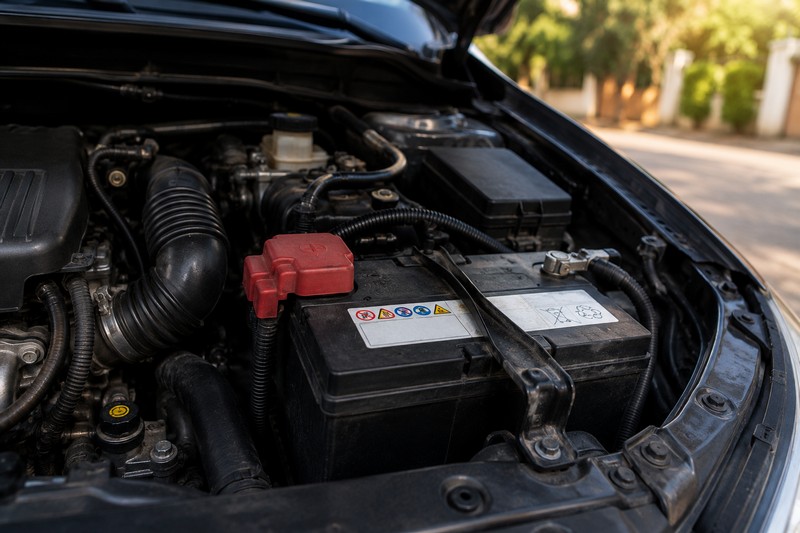
How Your Car Battery and Charging System Work
Your car battery has one primary job: to provide the high current burst needed to start the engine. Once the engine is running, the alternator — a generator driven by the engine — takes over and provides all the electrical power the car needs while simultaneously recharging the battery. A healthy charging system means the battery is always topped up after starting.
When the battery keeps dying, it means either the battery is not being recharged sufficiently, something is draining it when the car is parked, or the battery itself can no longer hold a charge. All three have different causes and different fixes — and a battery replacement alone will not solve the first two.
7 Most Common Causes in Kenya
1. Battery Past Its Service Life
The most straightforward cause — the battery is simply old and can no longer hold a sufficient charge. Car batteries in Kenya's heat typically last 2–4 years, compared to 4–6 years in cooler climates. Heat accelerates the chemical degradation inside the battery cells, reducing capacity gradually until the battery can no longer reliably start the engine — particularly on cool mornings when more cranking power is needed.
An old battery may start the car fine when recently driven but fail to hold enough charge overnight, or after a few days of the car sitting unused. The battery may also start the car normally in hot weather but fail on a cool highland morning. If your battery is over 3 years old and keeps going flat, replacement (Ksh 4,000–12,000) is the correct first step. Reliable brands in Kenya include Exide, Bosch, Amaron and N-Power.
2. Failing Alternator
The alternator is the component that recharges the battery while the engine is running. A failing alternator that is not producing sufficient charge voltage allows the battery to slowly drain during every drive rather than being replenished. The result is a battery that becomes progressively flatter over several days of driving until it can no longer start the car.
Signs of a failing alternator alongside a flat battery include: dashboard warning lights flickering or dimming headlights at idle, a battery-shaped warning light on the dashboard, and the battery going flat even though it is relatively new. A healthy alternator should produce 13.8–14.4 volts across the battery terminals with the engine running — most Nairobi garages can test this for free in two minutes. Alternator replacement costs Ksh 8,000–25,000 depending on the vehicle. Find an electrical specialist for testing.
With the engine running, check your dashboard voltmeter if you have one — it should read 13.5–14.5V. No voltmeter? Ask any Nairobi garage or petrol station with a battery tester to check your alternator output. It takes two minutes and is usually free. If output is below 13.5V, the alternator is not charging the battery properly.
3. Parasitic Electrical Drain
A parasitic drain is an electrical component that continues drawing current from the battery after the car is switched off and all systems should be dormant. A small amount of parasitic drain is normal — the ECU, clock and central locking all draw tiny amounts of current permanently. The problem is when a faulty component draws significantly more than it should, draining the battery over hours or days.
Common causes of excessive parasitic drain in Kenyan vehicles include a faulty aftermarket car alarm or immobiliser that stays active, an interior light that does not switch off (often a boot or door that does not close fully), a faulty relay that keeps a component energised, and aftermarket audio systems with always-on amplifiers. The drain can be measured with a multimeter — a normal parked car should draw less than 50 milliamps. Anything above 100 milliamps indicates an abnormal drain that needs finding and fixing. Diagnosis and repair by an electrical specialist typically costs Ksh 2,000–8,000.
4. Corroded or Loose Battery Terminals
Corroded or loose battery terminals are extremely common in Kenya and cause two related problems. First, corrosion creates electrical resistance that prevents the battery from being fully recharged by the alternator — current cannot flow efficiently through a corroded connection. Second, a loose terminal means the battery may not be connected reliably — the car may start fine one moment and have no power the next.
White or blue-green powdery deposits on the battery terminals are the visible sign of corrosion. Cleaning takes 10 minutes with baking soda, water and an old toothbrush. Disconnect the negative terminal first, clean both terminals and the cable ends, reconnect positive first then negative, and coat lightly with petroleum jelly to slow future corrosion. This is free to do yourself and should be checked every six months in Kenya's humidity.
5. Short Trips Not Recharging the Battery
Starting the engine consumes a significant amount of battery charge. The alternator then needs 20–30 minutes of running to fully restore that charge. If you make many very short trips — common in Nairobi for school runs, brief errands and short commutes in the Industrial Area — the battery never fully recovers between starts and gradually becomes more and more depleted over days and weeks until it can no longer start the car.
This is particularly common for vehicles used mainly in central Nairobi where distances are short and traffic is slow (low alternator output at idle). The solution is either a longer drive 2–3 times per week to allow full recharging, or the use of a battery charger (Ksh 2,000–4,000) to top up the battery periodically when the car is parked at home overnight.
6. Extreme Heat Damage
Kenya's equatorial heat — particularly in low-altitude areas like Mombasa, Kisumu and parts of Nairobi — accelerates the evaporation of the electrolyte fluid inside conventional battery cells. This permanently reduces battery capacity and shortens its life. Vehicles parked in direct sun all day in Kenya's hottest months face the worst of this. Some batteries in low-altitude, high-temperature regions of Kenya fail within 18 months.
Using a battery specifically rated for high-temperature climates, parking in shade wherever possible, and ensuring the battery is properly secured (vibration also accelerates degradation) all help extend battery life in Kenya's conditions.
7. Faulty Aftermarket Car Alarm or Tracker
Aftermarket car alarms, GPS trackers and immobilisers fitted to vehicles in Kenya are a surprisingly common cause of battery drain problems. A poorly fitted or faulty alarm system can draw significantly more current than specified, draining the battery overnight. Some trackers with cellular connectivity constantly check in with the network, consuming substantial current especially in areas with poor signal where the device keeps searching.
If your battery drain problem started shortly after fitting a new alarm, tracker or any other aftermarket electrical device, that device is the prime suspect. Have the installation inspected by an auto electrical specialist — incorrect wiring is very common with aftermarket installations from roadside fitters in Kenya.
How to Diagnose the Problem
-
Check the battery age firstLook for a date sticker on the battery — most batteries have the manufacture date marked. If it is over 3 years old, replacement is the logical first step regardless of other potential causes. A battery test at any Nairobi garage takes 5 minutes and costs nothing or Ksh 200–500.
-
Test the alternator output with the engine runningAsk a garage to test alternator output voltage. Should be 13.8–14.4V with the engine running at idle. Below 13.5V means insufficient charging. A full alternator load test is more thorough — ask for this if the basic voltage check is borderline.
-
Check for parasitic drain if battery and alternator are goodIf you have a new battery and a good alternator but the battery still goes flat, a parasitic drain is the likely cause. Ask a garage to do a parasitic draw test — a multimeter in series with the battery measures current draw with everything switched off. Above 50–100 milliamps indicates an abnormal drain.
-
Check and clean battery terminalsInspect both terminals for white or green corrosion. Clean with baking soda and water if corroded. Ensure both terminals are tight — wiggle them firmly. A terminal that moves at all needs tightening or replacing.
-
Book a full electrical diagnosis if problem persistsIf the battery is new, the alternator is charging correctly, and no obvious drain is found, an auto electrician needs to do a comprehensive diagnosis. Find a specialist on fixmycar.ke.
Repair Costs in Kenya (2025)
| Problem / Fix | Est. Cost (Ksh) | Urgency | Notes |
|---|---|---|---|
| Battery terminal cleaning | Free – 500 | DIY | Baking soda and water — do it yourself |
| Battery test | Free – 500 | First Step | Most garages and petrol stations test for free |
| Battery replacement | 4,000 – 12,000 | Urgent | Exide, Bosch, Amaron — avoid unknown brands |
| Alternator test | Free – 1,000 | First Step | Test before replacing — confirm it is actually faulty |
| Alternator replacement | 8,000 – 25,000 | Urgent | Reconditioned units available and reliable |
| Parasitic drain diagnosis | 2,000 – 5,000 | Medium | Essential if battery and alternator are both good |
| Parasitic drain repair | 1,500 – 8,000 | Medium | Varies hugely depending on what is causing the drain |
| Battery charger (home use) | 2,000 – 4,000 | Preventive | Useful if car sits unused for days regularly |
How to Extend Battery Life in Kenya
- Replace your battery proactively every 3 years. In Kenya's heat, waiting for complete failure means being stranded. A planned replacement at 3 years costs the same as an emergency replacement — minus the inconvenience and potential towing cost.
- Drive for at least 20–30 minutes two to three times per week. Short city trips do not fully recharge the battery. Regular longer drives — or at least keeping the engine running for 30 minutes — allow the alternator to fully replenish what starting consumed.
- Clean battery terminals every six months. Kenya's humidity corrodes terminals quickly. Apply petroleum jelly after cleaning to slow the process. Takes 10 minutes and keeps your electrical connections reliable.
- Invest in a battery charger if you park for extended periods. If your car sits unused for more than 3–4 days regularly — during travel, over holiday periods, or if you have a second vehicle — a trickle charger (Ksh 2,000–4,000) connected overnight keeps the battery in good condition indefinitely.
- Park in shade wherever possible. Nairobi's sun significantly accelerates battery degradation. A shaded parking spot adds months to battery life, particularly in lower-altitude and hotter areas.
- Switch off all electrical loads before switching off the engine. Leaving the AC, headlights or audio system running momentarily after switching off the ignition draws battery current. Make switching these off part of your parking routine.
- Have your charging system tested annually. An annual alternator and battery test catches a weakening alternator before it starts causing flat batteries. Most auto electrical specialists in Nairobi do this for free or at minimal cost.
Find an Auto Electrician Near You
Search verified auto electrical specialists and garages across Nairobi and Kenya on FixMyCar. Get your charging system tested and battery problem solved properly.
Find an Electrician Near You →Free to search · No booking fees · 400+ garages listed