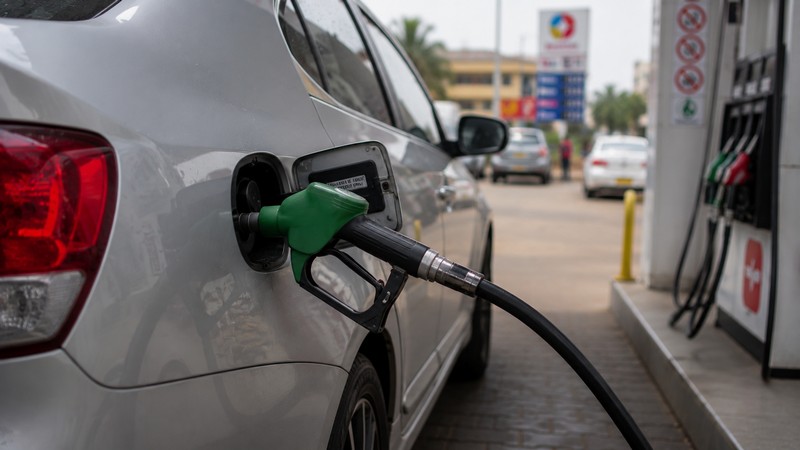
Why Fuel Consumption Is High in Kenya
Fuel is one of the biggest running costs for any Kenyan driver. With petrol prices regularly exceeding Ksh 200 per litre in Nairobi, even a small increase in fuel consumption adds up to significant money over a month. A car that uses 2 extra litres per 100 km costs an additional Ksh 4,000–6,000 per month for a driver covering 100 km per day in the city.
Several factors make fuel consumption in Kenya inherently higher than the manufacturer's official figures — slow traffic, stop-start driving, altitude, poor road surfaces and the heat all play a role. But there is a significant difference between normal Kenya-adjusted consumption and genuinely excessive consumption caused by a mechanical problem or poor maintenance. The causes below are the ones that cost you real money and are entirely fixable.
8 Most Common Causes of High Fuel Consumption in Kenya
1. Underinflated Tyres
This is the single easiest and cheapest fuel consumption problem to fix — and one of the most common in Kenya. When tyre pressure is too low, the contact patch between the tyre and the road increases, creating more rolling resistance. The engine has to work harder to move the car, burning more fuel. A tyre that is 20% underinflated increases fuel consumption by approximately 2–3% — across four tyres, the effect compounds.
Kenya's roads are particularly hard on tyre pressure. Slow punctures from murram road debris are extremely common, and many drivers lose significant pressure over days without noticing. Check your tyre pressure at least once a month — when the tyres are cold, before driving. Correct pressures are on the sticker inside the driver's door or in the owner's manual. A tyre pressure gauge costs Ksh 200–500 and most petrol stations in Nairobi offer free air.
2. Dirty or Clogged Air Filter
Your engine needs a precise mixture of air and fuel to run efficiently. The air filter removes dust and debris from the air entering the engine. In Kenya's dusty conditions — particularly after driving on murram roads or during dry season — the air filter clogs much faster than in most countries. A clogged air filter restricts airflow to the engine, forcing it to burn more fuel to compensate for the reduced oxygen supply.
A severely clogged air filter can increase fuel consumption by 10% or more. Air filter replacement is one of the cheapest services available — a new filter costs Ksh 500–1,500 and should be changed every 15,000–20,000 km in Kenyan conditions, compared to the manufacturer's typical recommendation of 30,000–40,000 km. Have yours replaced as part of your regular general maintenance service.
After driving on murram roads in the dry season, tap your air filter against your hand. If a cloud of red dust falls out, it needs replacing regardless of mileage. In areas like Ngong, Kitengela or any upcountry route, filters clog far faster than the standard service interval suggests.
3. Worn Spark Plugs
Spark plugs ignite the fuel-air mixture in the engine's cylinders. As they wear over time, the spark becomes weaker and less consistent — some fuel passes through the cylinder without igniting properly. This incomplete combustion wastes fuel directly. A misfiring cylinder means the engine is running on less than its full capacity, so it demands more throttle to produce the same power — burning more fuel in the process.
Worn spark plugs typically cause noticeably rougher idling, slightly reduced power (especially on hills), and occasionally a visible hesitation when accelerating. Spark plug replacement in Nairobi costs Ksh 1,500–5,000 for a full set depending on the vehicle and plug type. Iridium plugs cost more but last significantly longer — worth considering for high-mileage vehicles.
4. Dirty Fuel Injectors
Fuel injectors spray a precisely measured mist of fuel into the engine's cylinders. Over time, carbon deposits build up on the injector tips and disrupt the spray pattern — producing a stream rather than a fine mist. This uneven fuel delivery reduces combustion efficiency significantly and increases consumption. Dirty injectors also cause rough idling, a slight loss of power, and sometimes a smell of unburnt fuel from the exhaust.
Injector cleaning — either chemically through a fuel additive, or professionally with ultrasonic cleaning equipment — restores the correct spray pattern and typically improves fuel economy noticeably. Professional injector cleaning in Nairobi costs Ksh 3,000–8,000 and is worth doing every 40,000–60,000 km. Find a fuel system specialist near you.
5. Faulty Oxygen Sensor
The oxygen sensor monitors the exhaust gases leaving the engine and sends data to the engine control unit (ECU) to adjust the fuel-air mixture in real time. If the oxygen sensor fails or gives incorrect readings, the ECU cannot optimise the mixture — and typically defaults to a richer (more fuel) setting to protect the engine. A faulty oxygen sensor is one of the most common causes of a sudden, significant increase in fuel consumption in modern vehicles, often accompanied by the check engine light coming on.
Oxygen sensor replacement in Nairobi costs Ksh 4,000–12,000 depending on the vehicle and sensor location. If your check engine light is on alongside increased fuel consumption, have the ECU fault codes read at a diagnostic specialist — the fault code will point directly to the failing sensor.
6. Dragging Brakes
If your brakes are not fully releasing when you lift your foot off the brake pedal — due to a partially seized caliper, a stiff brake cable, or a collapsed brake hose — one or more wheels is dragging constantly against the brake pad. The engine must work harder to overcome this continuous resistance, burning significantly more fuel. A dragging brake also causes the affected wheel to overheat and the brake pads and discs to wear prematurely.
Signs of dragging brakes include a car that feels sluggish or harder to push forward than normal, a burning smell from a wheel after driving, or uneven heating of the wheel hubs. This needs prompt attention — it is both a fuel waste and a safety issue. Have your brakes inspected at a reputable garage.
7. Using the Wrong Engine Oil
Engine oil viscosity has a direct effect on fuel consumption. Using oil that is thicker than the manufacturer specifies — for example, using 20W-50 in a modern engine designed for 5W-30 — increases internal friction in the engine, requiring more fuel to overcome it. This is a surprisingly common issue in Kenya because many garages use a universal thick oil for everything, regardless of the manufacturer's specification.
Always use the oil grade specified in your owner's manual. For most modern Japanese vehicles popular in Kenya — Toyota, Subaru, Nissan — this is typically 5W-30 or 0W-20. Using the correct oil grade can reduce fuel consumption by 1–3% and also improves engine protection. Ask your garage to confirm the grade before your next oil change.
8. Excessive Idling in Nairobi Traffic
A car idling in traffic consumes fuel at approximately 0.5–1.0 litres per hour depending on engine size, while providing zero kilometres of travel. Nairobi drivers often spend 1–2 hours per day idling in traffic on routes like Mombasa Road, Thika Road and Ngong Road during peak hours. Over a month, this represents 15–60 litres of fuel consumed entirely at standstill.
While you cannot avoid all traffic, some habits make it significantly worse — leaving the engine running while parked waiting, not using start-stop systems where fitted, and running the AC at maximum in stationary traffic all contribute. Switching off the engine when stationary for more than 2–3 minutes saves measurable fuel over time.
How to Check Your Fuel Consumption
Before spending money at a garage, establish your actual current fuel consumption accurately. This gives you a baseline to compare against after any repairs.
-
Fill the tank completely and reset your trip meterFill your tank to the brim at a petrol station and reset your trip odometer to zero. Note the date and the cost per litre you paid.
-
Drive normally for at least 300–400 kmUse the car as you normally would — a mix of city and highway driving gives the most representative result. Do not change your driving style during this period.
-
Fill up again completely and note the litres addedFill to the brim again at the same station if possible. Note exactly how many litres were added to refill the tank, and read your trip meter distance.
-
Calculate: litres used ÷ km driven × 100For example: 45 litres used over 350 km = 45 ÷ 350 × 100 = 12.9 litres per 100 km. Compare this to the normal range for your vehicle type. Significantly above normal = investigate the causes above.
-
Start with the cheap fixes firstCheck tyre pressure (free), replace the air filter (Ksh 500–1,500), and change the oil to the correct grade. If consumption is still high after these, book a diagnostic check at a garage on fixmycar.ke.
Repair Costs in Kenya (2025)
| Fix / Service | Est. Cost (Ksh) | Fuel Saving Potential | Notes |
|---|---|---|---|
| Tyre pressure correction | Free – 200 | 2–3% | Check monthly — most impactful free fix |
| Air filter replacement | 500 – 1,500 | Up to 10% | Every 15,000–20,000 km in Kenya |
| Spark plug replacement | 1,500 – 5,000 | 5–8% | Iridium plugs last longer — worth the premium |
| Injector cleaning (chemical) | 500 – 1,500 | 3–5% | Fuel additive — easiest starting point |
| Injector cleaning (professional) | 3,000 – 8,000 | 5–10% | More effective for heavily fouled injectors |
| Oxygen sensor replacement | 4,000 – 12,000 | 10–15% | Often triggers check engine light — diagnose first |
| Brake caliper service | 3,000 – 12,000 | Significant | Dragging brakes waste fuel and destroy pads |
| Oil change (correct grade) | 2,000 – 5,000 | 1–3% | Always use manufacturer-specified viscosity |
Driving Habits That Save Fuel in Kenya
Mechanical fixes matter, but driving style accounts for as much as 20–30% of real-world fuel consumption. These habits are worth adopting alongside any repairs.
- Accelerate gently from junctions and roundabouts. Aggressive acceleration from stops is the biggest single driving-style contributor to high fuel consumption in city driving. Smooth, gradual acceleration can reduce consumption by 15–20% in stop-start Nairobi traffic.
- Anticipate traffic ahead and coast to stops. Lifting off the accelerator early and coasting to a red light uses near-zero fuel on modern fuel-injected vehicles. Braking from full speed to a stop immediately wastes all the fuel used to build that speed.
- Keep your speed below 100 km/h on the highway. Aerodynamic drag increases with the square of speed — driving at 120 km/h uses roughly 40% more fuel than driving at 90 km/h. The Nairobi–Mombasa highway is where this makes the biggest difference.
- Remove unnecessary weight from your car. Many Kenyan drivers carry heavy loads in the boot permanently. Every 50 kg of extra weight increases fuel consumption by approximately 1–2%.
- Switch off the engine if stationary for more than 2 minutes. Idling consumes 0.5–1.0 litres per hour with zero kilometres covered. In Nairobi's worst traffic jams, switching off saves measurable fuel over a month.
- Service your car on schedule. A well-maintained engine runs more efficiently. Find a general maintenance specialist near you and book a full service if it is overdue.
Book a Fuel Efficiency Check Today
Find verified mechanics and diagnostic specialists across Nairobi and Kenya. A proper service can cut your monthly fuel bill significantly.
Find a Mechanic Near You →Free to search · No booking fees · 400+ garages listed