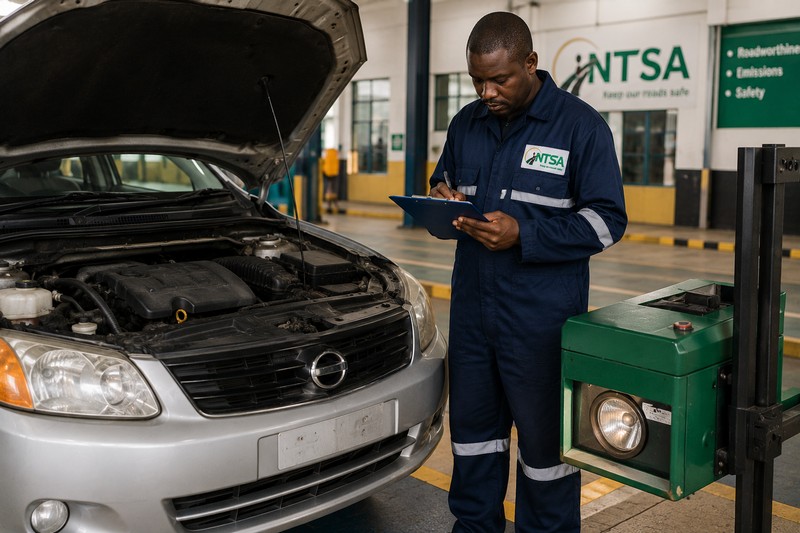
What NTSA Inspects
The NTSA (National Transport and Safety Authority) vehicle inspection — also known as the motor vehicle inspection certificate (MVIC) — is a mandatory annual roadworthiness check for all vehicles on Kenyan roads. The inspection covers the major safety systems of the vehicle and is conducted at NTSA-approved inspection centres across Kenya, including locations in Nairobi, Mombasa, Kisumu, Nakuru and other major towns.
Understanding exactly what the inspector checks allows you to address potential failure points before you arrive. The inspection covers the following main areas:
- Braking system: Brake effectiveness, balance between left and right, parking brake function, brake pedal feel.
- Lights and electrical: Headlights (alignment and brightness), brake lights, indicators, hazard lights, reversing lights, number plate lights.
- Steering and suspension: Steering play, wheel bearing condition, ball joint and tie rod end condition, shock absorber effectiveness.
- Tyres and wheels: Tread depth, tyre condition (no bulges or cracks), correct matching of tyre sizes, wheel rim condition.
- Emissions: Exhaust smoke opacity test — particularly strict on diesel vehicles, and checked on petrol vehicles too.
- Body and structure: Windscreen condition, wiper effectiveness, horn function, mirrors, door operation, visible structural damage or corrosion.
- Underbody: Exhaust system integrity, fuel system condition, visible fluid leaks, structural rust.
Most Common Failure Reasons in Kenya
1. Brake System Failures
Brake-related issues are the most common cause of NTSA inspection failure in Kenya. The inspection includes a brake efficiency test — the car is driven or rolled onto a brake testing machine that measures the braking force at each wheel. Common failures include:
- Insufficient overall brake efficiency — worn brake pads that do not provide enough stopping force to meet the minimum threshold.
- Brake imbalance — significantly different braking force between the left and right wheels on the same axle, caused by a seized caliper, contaminated pads, or mismatched pad specifications.
- Parking brake failure — a handbrake that does not hold the vehicle on a gradient. Very common in Kenya on vehicles where the rear brake cables have stretched or corroded.
- Brake fluid leak — any visible brake fluid leak from a caliper, hose or master cylinder is an automatic failure.
Fix: Have brakes inspected and serviced at a brake specialist at least two weeks before inspection. Replace worn pads, address seized calipers and adjust or replace the parking brake cable if it does not hold properly.
Test your parking brake on a slope before inspection day. Apply the handbrake fully, select neutral and release the foot brake. If the car rolls at all, the parking brake will fail the inspection. Parking brake cable adjustment costs Ksh 500–2,000 and takes 30 minutes — do this in advance, not on the morning of the inspection.
2. Tyre Issues
Tyres are one of the easiest inspection failure points to avoid — and one of the most common failures in Kenya. The inspection checks:
- Tread depth: The legal minimum in Kenya is 1.6mm across the central three-quarters of the tread width. A tyre worn to or below this level fails immediately. The coin test — inserting a Ksh 1 coin into the tread groove: if you can see the full coin face, the tread is below 2mm and likely near or below the legal minimum.
- Tyre condition: Bulges, cuts, exposed cords, cracking sidewalls and other structural damage are all automatic failures. A tyre with a visible bulge — common in Kenya after pothole impacts — must be replaced before inspection.
- Matching tyres: Significantly different tyre sizes on the same axle, or mixing radial and cross-ply tyres, are inspection failures.
- Spare tyre: Some inspection centres check that the spare is present, inflated and in serviceable condition.
Fix: Replace any tyre with tread below 2mm — giving yourself a margin above the 1.6mm legal minimum. Inspect all tyres for bulges and sidewall damage. Budget Ksh 4,000–15,000 per tyre for replacement.
3. Lights and Electrical Failures
Lighting failures are extremely common NTSA inspection failures — often caused by blown bulbs that the driver has not noticed. The inspection checks every light on the vehicle. Common failures include:
- A blown brake light bulb — particularly common since many drivers cannot easily see whether their own brake lights are working.
- Headlights aimed incorrectly — too high, too low or pointing in the wrong direction. This is checked with specialist equipment.
- A non-functioning indicator — often one side has a blown bulb that the driver mistakes for a fast-flashing indicator.
- Number plate light not working — easily overlooked but checked at inspection.
- Reversing light not functioning — failed bulb or a fault with the reverse gear switch.
Fix: Do a full lights check yourself the evening before inspection — have a helper confirm brake lights, indicators and reversing lights while you operate them. Bulb replacement costs Ksh 100–500 per bulb and takes minutes. Headlight alignment adjustment costs Ksh 500–1,500 at most garages. Find an electrical specialist for any electrical faults.
4. Emissions Failure
The emissions test measures exhaust smoke opacity — how much of the exhaust is visible smoke rather than clean gases. This test is particularly strict on diesel vehicles and catches several common problems:
- Diesel vehicles: Worn or dirty injectors producing excessive black smoke are the most common cause of diesel emissions failure. An EGR valve stuck open or a blocked air filter also cause excessive smoke.
- Petrol vehicles: A very rich running engine producing black smoke, or a vehicle burning oil producing blue smoke, can fail the emissions test.
- Removed or failed catalytic converter: A vehicle with a removed or failed catalytic converter will almost always fail the emissions test on petrol vehicles.
Fix: Have diesel injectors tested and cleaned (Ksh 10,000–40,000) if the vehicle smokes under acceleration. Replace a clogged air filter (Ksh 500–2,000) as an inexpensive first step. Have the catalytic converter inspected if the check engine light is on. Find a fuel system specialist for injector work.
5. Steering and Suspension Failures
Steering and suspension checks at NTSA inspection identify unsafe play in steering components and failed suspension parts. Common failures include:
- Excessive steering play — more than the allowed amount of free movement in the steering wheel before the wheels begin to turn, caused by worn steering rack, tie rod ends or steering column joints.
- Worn ball joints or tie rod ends — detectable by the inspector feeling for play when shaking the wheel with the car on a ramp.
- Failed shock absorbers — the bounce test or a dedicated shock absorber testing machine identifies shocks that have lost their damping ability.
- Broken coil spring — visible when the car is on the ramp and very commonly found on Kenyan vehicles.
Fix: Have suspension inspected at a suspension specialist before inspection. Replace worn ball joints, tie rod ends and shock absorbers. Budget Ksh 3,000–15,000 per component depending on the part and vehicle.
6. Windscreen and Wiper Failures
Windscreen and wiper failures are easily overlooked but caught at inspection:
- Windscreen cracks in the driver's line of sight — any crack that passes through the area directly in front of the driver is an automatic failure. Small chips outside this area may pass but are noted.
- Wiper blades that do not clear the screen effectively — torn, streaking or chattering wipers fail the inspection. In Kenya, wiper blades deteriorate faster than normal due to UV exposure and the dust that abrades the rubber.
- Windscreen washer not functioning — an empty washer reservoir or a failed washer pump is a failure point.
Fix: Replace wiper blades if they are more than 12 months old or streak and chatter (Ksh 500–2,000 per pair). Have windscreen cracks in the driver's vision zone repaired or the screen replaced before inspection (Ksh 8,000–25,000 for replacement). Fill the washer reservoir.
7. Fluid Leaks and Underbody Issues
The underbody inspection checks for visible fluid leaks and structural concerns:
- Oil leaks — any dripping oil from the engine, gearbox or differentials is noted and may cause failure.
- Brake fluid leaks — automatic failure. Any wet areas around brake components must be investigated and fixed.
- Fuel system leaks — any fuel smell or visible fuel leak is an automatic failure and a fire risk.
- Severe underbody corrosion — structural rust that has compromised the chassis or key mounting points is a failure. This is more common on vehicles from coastal areas where salt air accelerates corrosion.
Fix: Have the engine degreased and inspected for leaks 2–3 weeks before inspection. Allow enough time to identify and fix any leaks found. Find an engine specialist to locate and repair oil leaks.
How to Prepare Your Car for NTSA Inspection
-
Book a pre-inspection service 2 weeks before inspection dayGive yourself enough time to fix anything found. A pre-inspection check at a reputable garage costs Ksh 1,000–3,000 and identifies the most common failure points systematically. Find a trusted garage on fixmycar.ke.
-
Check all lights yourself the evening beforeWalk around the car with a helper. Check headlights, brake lights (both sides), indicators (front and rear, both sides), hazard lights, reversing lights and number plate light. Replace any blown bulbs — they cost Ksh 100–500 each and take minutes.
-
Inspect all four tyres carefullyCheck tread depth using a coin or tread depth gauge. Look for bulges, sidewall cracks and cuts. Ensure all four tyres match in size. Check the spare is present and inflated. Replace any tyre that fails this check before inspection day.
-
Test the parking brake on a slopeFind a hill, apply the handbrake fully, select neutral and release the foot brake. The car must not move. If it rolls, have the parking brake cable adjusted or replaced before inspection — Ksh 500–2,000.
-
Check windscreen, wipers and washerLook for cracks in the driver's direct field of view. Run the wipers and check they clear the screen completely without streaking. Check the washer squirts correctly. Fill the washer reservoir if low.
-
Check horn, mirrors and doorsThe horn must work. All mirrors must be present, uncracked and adjustable. All doors must open and close properly from both inside and outside. These take 2 minutes to check and are easy fixes if found wanting.
Pre-Inspection Repair Costs in Kenya (2025)
| Item / Repair | Est. Cost (Ksh) | Priority | Notes |
|---|---|---|---|
| Pre-inspection service / check | 1,000 – 3,000 | First Step | Book 2 weeks before inspection day |
| Bulb replacement (per bulb) | 100 – 500 | Low | Check all lights the evening before |
| Wiper blade replacement (pair) | 500 – 2,000 | Low | Replace annually in Kenya's UV conditions |
| Parking brake adjustment | 500 – 2,000 | Medium | Test on a slope before inspection day |
| Brake pad replacement (per axle) | 3,000 – 10,000 | Medium | Replace if worn — brakes are the top failure cause |
| Tyre replacement (per tyre) | 4,000 – 15,000 | Medium | Replace any tyre below 2mm tread or with bulges |
| Headlight alignment | 500 – 1,500 | Medium | Often overlooked — checked at inspection |
| Ball joint / tie rod replacement | 3,000 – 12,000 | High | Safety-critical — fix regardless of inspection |
| Windscreen replacement | 8,000 – 25,000 | High | Only if crack is in driver's direct line of vision |
| Diesel injector service | 10,000 – 40,000 | High | Failing emissions test — start with air filter first |
Tips for Passing First Time
- Book early in the morning. Inspection centres in Kenya — particularly in Nairobi — get very busy by mid-morning. An early appointment means shorter queues, less waiting time and inspectors who are fresh rather than fatigued from a long day.
- Bring all required documents. Arrive with your logbook, insurance certificate, and any previous inspection certificates. Missing documentation wastes the trip regardless of the vehicle's condition.
- Do not try to hide known faults. Inspectors are experienced and test systematically. A known fault that you attempt to conceal — such as a brake that feels fine when cold but fades after warming up — will be caught. Fix it properly in advance.
- Clean the car — particularly the lights. Dirt-covered headlights and brake lights can fail the brightness check even if the bulbs are fine. Clean all lenses thoroughly before inspection day.
- Warm the engine before the emissions test. The emissions test is most accurately performed on a fully warm engine. Drive to the inspection centre rather than being towed — a cold engine produces more emissions than a fully warmed one.
- Fix all known issues before going. Even if you think a problem might not be checked, fix it. NTSA inspection criteria evolve and inspectors have discretion. A car in genuinely good condition passes more consistently than one where specific items have been addressed while others are neglected.
- Use a reputable garage for pre-inspection work. Find a trusted mechanic on fixmycar.ke — garages that regularly prepare vehicles for NTSA inspection know exactly what the inspectors look for and will not miss common failure points.
Find a Garage for Your Pre-Inspection Service
Search 400+ verified garages across Nairobi and Kenya on FixMyCar. Book a pre-inspection service and pass your NTSA check first time.
Find a Garage Now →Free to search · No booking fees · 400+ garages listed