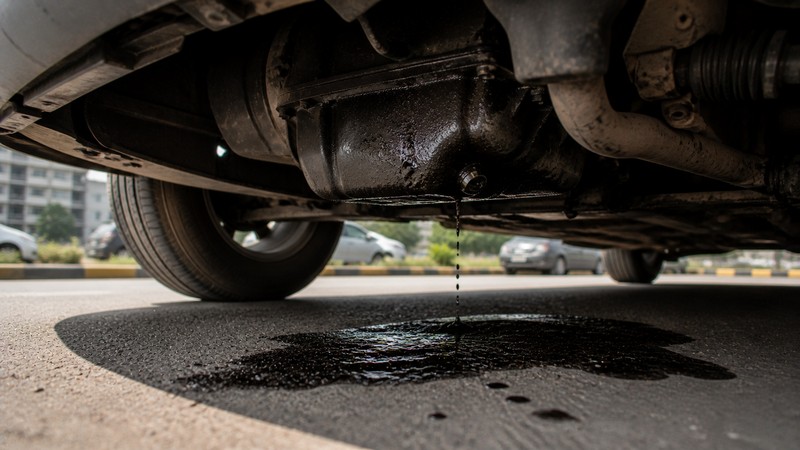
How to Identify an Oil Leak
Before diagnosing the cause, confirm that what you are seeing is actually engine oil. Several different fluids can leak from a car, and they look and smell different from each other.
- Engine oil: Dark brown to black, slippery and greasy, with a distinctive burnt oil smell. Usually found under the front or centre of the car.
- Gearbox or differential oil: Similar colour to engine oil but with a stronger, more sulphurous smell. Found further back under the car.
- Coolant: Green, blue, orange or pink depending on type. Sweet smell. Leaves a sticky residue when dry. Found near the front of the car.
- Brake fluid: Clear to slightly yellow, thin and slippery. Found near the wheels. Serious safety issue — see our guide on brake services.
- Power steering fluid: Clear to light red, oily. Found near the front wheels or under the bonnet.
- Water / condensation: Clear water dripping from under the car, especially near the exhaust or AC drain, is usually normal condensation — not a leak.
To pinpoint an engine oil leak, park on clean ground or lay a sheet of cardboard under the car overnight. The location of the stain tells you which area of the engine to inspect. Clean the engine with degreaser, then check again after a short drive — the fresh oil will show you exactly where it is coming from.
7 Most Common Causes of Oil Leaks in Kenya
1. Worn or Damaged Oil Pan Gasket
The oil pan (sump) sits at the very bottom of the engine and holds the engine oil. A rubber or cork gasket seals it to the engine block. Over time — and faster on Kenya's rough roads where the sump is vulnerable to stone strikes and scraping — this gasket hardens, cracks and begins to leak. An oil pan gasket leak typically produces a slow drip of oil directly below the front-centre of the car, leaving a dark stain on the ground where the car regularly parks.
This is one of the most common oil leaks in Nairobi garages. Oil pan gasket replacement costs Ksh 2,000–6,000 depending on the vehicle, and is straightforward on most cars. It is well worth fixing promptly — a gasket that starts as a slow drip can open up significantly over time.
2. Valve Cover Gasket Leak
The valve cover sits on top of the engine and protects the valvetrain components inside. The gasket that seals it to the cylinder head hardens and shrinks with age and heat cycles — eventually allowing oil to seep out from the top of the engine. Valve cover gasket leaks are particularly common in Kenya because heat deteriorates rubber gaskets faster in equatorial temperatures, and many vehicles on Kenyan roads are over 10 years old.
Signs of a valve cover gasket leak include a burning smell when the engine is hot (oil dripping onto the hot exhaust manifold below), visible oil residue on top of or around the sides of the engine, and blue-tinged smoke from the engine bay rather than the exhaust. Valve cover gasket replacement costs Ksh 2,500–7,000 and is one of the more straightforward engine leak repairs.
A burning smell from the engine bay when you stop after a drive — particularly noticeable after Nairobi's slow traffic — is often the first sign of a valve cover gasket leak. Oil dripping onto the hot exhaust manifold burns off immediately but leaves the smell. Do not ignore it — oil near hot exhaust components is also a fire risk.
3. Worn Crankshaft or Camshaft Seals
The crankshaft and camshaft both pass through the engine block or head and are sealed with rubber lip seals. As these seals age — particularly in high-mileage vehicles — they harden, shrink and begin to leak. Crankshaft seal leaks typically appear at the very front or rear of the engine. A rear main seal leak (at the back of the crankshaft) is particularly problematic because it is directly above the gearbox, and accessing it for replacement requires removing the gearbox — a significant labour cost.
Front crankshaft seal leaks are more accessible and cost Ksh 3,000–8,000 to repair. Rear main seal replacement costs Ksh 8,000–25,000 due to the gearbox removal required. Both seals are typically due for replacement on vehicles with over 120,000 km.
4. Oil Filter or Drain Plug Leak
After an oil change, a loose or incorrectly fitted oil filter or drain plug is a surprisingly common source of oil leaks in Kenya. Many roadside oil change garages in Nairobi do not torque the drain plug correctly, or use an oil filter without properly seating the rubber seal. The result is an oil leak that begins immediately after the service — sometimes dramatically so if the filter or plug is very loose.
If you notice an oil leak shortly after an oil change, this is the first thing to check. Inspect the oil filter (usually on the side of the engine) and the drain plug (at the bottom of the sump) for wetness. Tightening a loose component may stop the leak immediately. If the drain plug thread is stripped — also common when over-tightened — a Helicoil thread repair costs Ksh 1,500–3,000. Always use a reputable garage for your oil and fluid services.
5. Damaged Oil Pan (Sump)
Kenya's roads — particularly unmarked speed bumps, deep potholes and rough murram tracks — present a real physical threat to the oil pan. A direct strike from a rock or a hard grounding on a speed bump can crack or puncture the sump, causing an immediate and potentially serious oil leak. This is more common on low-ground-clearance vehicles like sedans and hatchbacks on upcountry or off-road routes.
A cracked sump can sometimes be repaired with specialist welding (Ksh 3,000–8,000) if the damage is not too severe. A punctured or badly damaged sump typically requires full replacement (Ksh 8,000–25,000 including a new gasket). If the oil pan is struck hard and oil loss is rapid, stop the engine immediately and do not restart until the oil level has been checked and the damage assessed.
6. Turbocharger Oil Leak
Turbocharged engines — increasingly common in Kenya on vehicles like the Subaru range, newer Toyota Hilux and various European cars — have engine oil fed to the turbocharger for lubrication and cooling. The seals within the turbocharger can wear over time, allowing oil to enter the intake or exhaust side of the turbo. Signs include blue or white smoke from the exhaust on acceleration or deceleration, an oil consumption increase without visible external leak, and sometimes a burning smell from the engine bay.
Turbocharger seal replacement or turbo rebuilding in Nairobi costs Ksh 15,000–50,000 depending on the turbo type and severity of the leak. Turbo replacement costs Ksh 40,000–150,000. Using the correct oil grade and changing oil on schedule is the most effective way to extend turbo seal life. Find engine repair specialists experienced with turbocharged vehicles.
7. Head Gasket Oil Leak
The head gasket seals the cylinder head to the engine block and must contain both combustion pressure and engine fluids — oil and coolant — simultaneously. When it begins to fail, it can leak oil externally at the head-to-block joint, or internally into the coolant or combustion chamber. External oil leaks from the head gasket area appear as oil seepage along the sides of the engine where the head meets the block.
A head gasket that is leaking oil externally may also be leaking coolant or combustion gases internally — symptoms include white smoke from the exhaust, a sweet smell from the coolant reservoir, or a milky appearance in the oil. Head gasket replacement is one of the most expensive engine repairs in Kenya, costing Ksh 50,000–200,000 depending on the engine and extent of damage. Early diagnosis significantly reduces total repair cost.
How Serious Is Your Leak?
Not all oil leaks require immediate emergency action, but all of them need attention. Use this guide to assess urgency.
| Leak Type | Urgency | What to Watch |
|---|---|---|
| Small stain on ground, oil level stable | Low | Check oil level weekly — fix within 2–4 weeks |
| Visible drip when parked, oil drops slightly | Medium | Top up oil level and fix within 1–2 weeks |
| Steady drip, oil level dropping noticeably | Urgent | Check oil level daily — fix immediately |
| Heavy leak or sudden oil loss | Stop Driving | Stop engine immediately — do not restart until inspected |
| Oil warning light on dashboard | Stop Now | Pull over and stop engine — risk of immediate engine damage |
If the oil pressure warning light (usually a red oil can symbol) illuminates while driving, pull over and switch off the engine as soon as it is safe to do so. This light indicates critically low oil pressure — not just low level. Continuing to drive for even a few minutes with the oil light on can cause irreversible engine damage.
Repair Costs in Kenya (2025)
| Repair | Est. Cost (Ksh) | Severity | Notes |
|---|---|---|---|
| Oil pan gasket replacement | 2,000 – 6,000 | Low | Very common repair in Nairobi garages |
| Valve cover gasket replacement | 2,500 – 7,000 | Low | Straightforward on most Japanese vehicles |
| Oil drain plug repair (Helicoil) | 1,500 – 3,000 | Low | Common after over-tightening at oil change |
| Front crankshaft seal | 3,000 – 8,000 | Medium | Often done with timing belt replacement |
| Rear main seal replacement | 8,000 – 25,000 | Medium | High labour — gearbox removal required |
| Oil pan replacement | 8,000 – 25,000 | Medium | Common after physical road damage in Kenya |
| Turbocharger seal / rebuild | 15,000 – 50,000 | High | Turbo replacement costs significantly more |
| Head gasket replacement | 50,000 – 200,000 | High | Early diagnosis reduces total repair cost |
How to Prevent Oil Leaks in Kenya
- Check your oil level every two weeks. Pull out the dipstick, wipe it clean, reinsert fully and read it. Takes 60 seconds and is the single most important check you can do. The level should be between MIN and MAX — top up if below the midpoint.
- Use the correct oil grade for your engine. Using thicker oil than specified increases pressure on ageing seals and gaskets, accelerating leaks. Check your owner's manual for the correct viscosity. Have it confirmed at your next oil service.
- Change your engine oil on schedule. Old, degraded oil loses its lubricating properties and also becomes acidic — which attacks rubber gaskets and seals from the inside. Change oil every 5,000–7,500 km for conventional oil, or 10,000 km for full synthetic.
- Have your oil filter and drain plug checked after every oil change. Take a look underneath within the first few days of an oil change. A small wet patch near the filter or drain plug means it was not fitted correctly — return to the garage immediately.
- Drive carefully over speed bumps and rough sections. Kenya's unmarked speed bumps and rocky murram tracks are a primary cause of oil pan damage. Slow right down — even 5 km/h — when crossing suspected obstacles at night or on unfamiliar roads.
- Have your engine inspected for leaks annually. A good mechanic will spot the early stages of a gasket or seal leak during a routine service — before it becomes a drip. Find a trusted garage for a full engine inspection.
Find an Engine Specialist Near You
Search verified mechanics and engine repair specialists across Nairobi and Kenya on FixMyCar. Get your oil leak diagnosed and fixed before it becomes a bigger problem.
Find a Mechanic Near You →Free to search · No booking fees · 400+ garages listed