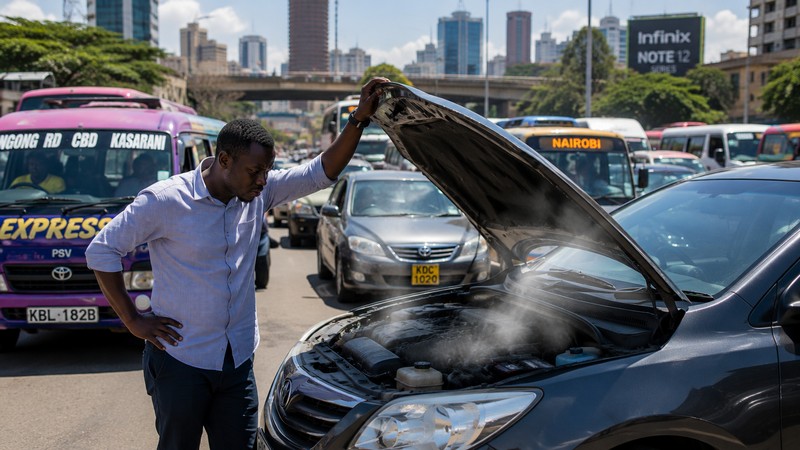
Why Cars Overheat in Nairobi Traffic
Your car's cooling system is designed to work best when the vehicle is moving. At speed, air flows through the radiator and carries heat away from the engine. In slow-moving traffic — like the daily standstill on Ngong Road or at the Globe roundabout — that airflow disappears. The engine keeps generating heat, but the cooling system struggles to remove it fast enough.
Nairobi's conditions make this worse than most cities. The city sits at 1,700 metres above sea level, meaning thinner air and reduced cooling efficiency. Average speeds during peak hours on major routes drop below 10 km/h for hours at a time. Combined with an ageing Japanese import that has never had its coolant flushed, overheating is almost inevitable.
Understanding the root cause is the difference between a Ksh 2,000 fix and a Ksh 150,000 engine repair.
6 Most Common Causes of Overheating in Kenya
1. Low or Contaminated Coolant
Coolant — a mix of antifreeze and water — is the fluid that carries heat away from your engine and disperses it through the radiator. If the level is low due to a slow leak or evaporation over time, there is simply not enough fluid to do the job. Equally damaging is old, contaminated coolant that has not been flushed in several years — it loses its heat-transfer properties and begins to cause corrosion inside your engine's water passages.
This is the single most common cause of overheating in Kenyan cars. Many vehicles on Nairobi roads have never had their coolant professionally flushed — a service that costs between Ksh 1,500 and Ksh 2,500 and should be done every two years.
Many Nairobi drivers top up coolant with plain water instead of the correct 50/50 coolant-to-water mix. Plain water has a lower boiling point, promotes rust inside your engine, and significantly increases overheating risk — especially in Nairobi's slow traffic.
2. Faulty Thermostat
The thermostat is a small valve that controls when coolant is allowed to flow from the engine to the radiator. If it gets stuck in the closed position — the most common failure mode — coolant cannot circulate at all. The engine overheats rapidly, particularly in slow traffic where airflow cannot compensate. Thermostat failure is extremely common in vehicles over five years old, which includes the vast majority of Kenya's Japanese import fleet. Replacement costs Ksh 2,000–6,000 including parts and labour.
3. Broken or Weak Radiator Fan
When your car is stuck in Nairobi traffic, the only thing moving air through the radiator is the electric cooling fan mounted behind it. If this fan is not working properly — broken motor, blown fuse, or a faulty temperature sensor — heat accumulates rapidly. A classic sign is a temperature gauge that rises when you are stationary but drops back to normal when you start moving again.
4. Leaking or Blocked Radiator
Nairobi's roads constantly throw stones, dust and debris at the front of your car. Over time, the aluminium fins on your radiator get damaged and blocked with mud, especially on unpaved roads upcountry. A partially blocked radiator cannot dissipate heat efficiently even when everything else is working correctly. Small leaks around hose connections also develop over time — checking your coolant reservoir monthly takes 30 seconds and can save you from a major repair.
5. Failing Water Pump
The water pump circulates coolant through the entire cooling system. If its impeller is worn or corroded, coolant flow drops dramatically and the engine overheats even if the coolant level is correct. Because the water pump is usually accessed during a timing belt replacement, Nairobi mechanics will often recommend replacing both at the same time — the additional cost for the pump is small compared to the labour saved.
6. Blown Head Gasket
A blown head gasket allows combustion gases to enter the cooling system, creating pressure that forces coolant out. Warning signs include white smoke from the exhaust, a sweet smell from the engine bay, and coolant level dropping regularly with no visible external leak. Head gasket replacement is the most expensive overheating repair — expect to pay Ksh 50,000 to Ksh 200,000 or more depending on the engine type.
What to Do When Your Car Overheats
-
Pull over safely and switch off the engineAs soon as the temperature gauge enters the red zone or you see steam, indicate and find a safe place to stop. Switch the engine off immediately — do not try to nurse the car to a garage.
-
Do not open the bonnet for at least 15 minutesThe cooling system is under pressure when hot. Wait until you can comfortably hold your hand near — not on — the engine area. Attempting to open the radiator cap on a hot engine can cause boiling coolant to spray out and cause serious burns.
-
Check the coolant reservoir levelLocate the coolant reservoir — usually a translucent plastic tank near the radiator with MIN and MAX markings. If it is empty or below the minimum line, low coolant is your likely problem.
-
Top up carefully as a temporary measureIf the engine is cool, carefully add water to the reservoir to bring it to the MIN line. This is a temporary fix only. Always use the reservoir — never open the radiator cap directly on a hot engine.
-
Drive to a garage or arrange a towIf the temperature stays normal after topping up, drive carefully to the nearest garage. If the gauge rises again, stop immediately and arrange a tow. Find a nearby garage on fixmycar.ke.
Never pour cold water onto a hot engine block. The sudden thermal shock can crack the engine block or cylinder head — turning a Ksh 5,000 thermostat repair into a Ksh 150,000+ engine replacement.
Repair Costs in Kenya (2025)
The table below gives realistic cost ranges at reputable Nairobi garages. Always get at least two quotes before authorising any repair above Ksh 10,000.
| Repair / Service | Est. Cost (Ksh) | Severity | Notes |
|---|---|---|---|
| Coolant top-up & flush | 1,500 – 2,500 | Low | Do every 2 years regardless of symptoms |
| Thermostat replacement | 2,000 – 6,000 | Low | Part is cheap; varies by engine access |
| Radiator fan replacement | 4,000 – 15,000 | Medium | OEM fans last significantly longer |
| Radiator flush / repair | 3,000 – 20,000 | Medium | Full replacement at the higher end |
| Water pump replacement | 8,000 – 25,000 | Medium | Replace with timing belt to save on labour |
| Head gasket replacement | 50,000 – 200,000 | High | Varies hugely by engine type and damage |
How to Prevent Overheating
- Check your coolant level once a month. The reservoir is marked MIN and MAX — the level should always be between them.
- Flush and replace coolant every two years. Old coolant loses efficiency and corrodes engine components. A flush costs Ksh 1,500–2,500.
- Watch your temperature gauge in traffic. A gauge creeping above the midpoint is an early warning — act before it reaches red.
- Service cooling components with the timing belt. Water pump, thermostat and hoses are often accessed at the same time — replacing them together saves significant labour cost.
- Rinse your radiator after driving on murram roads. Use a garden hose at low pressure to clear mud and debris from the radiator fins.
- Book a cooling system check before the long rains. April–June brings the worst Nairobi traffic. A pre-rains cooling check costs Ksh 500–1,000 at most garages.
Find a Trusted Mechanic Near You
Search 400+ verified auto repair shops across Nairobi and Kenya. Compare services, read reviews and book online.
Find a Garage Now →Free to search · No booking fees · 400+ garages listed