How to Identify the Source
Before visiting a garage, narrow down where the smell is coming from. This saves significant diagnostic time and prevents you from being charged for unnecessary inspections. Note the following before you go:
- When does the smell occur? Only when braking, only when accelerating, continuously while driving, or only after parking?
- Where does it seem to come from? From the engine bay, from under the car, from inside the cabin through the vents, or from a specific wheel area?
- How long has it been happening? Started suddenly, or gradually getting stronger over days?
- Any other symptoms? Smoke, unusual noise, warning lights, reduced performance?
After parking, walk around all four wheels and carefully hold your hand near — not on — each wheel hub. Significantly more heat from one wheel than the others points directly to a braking or bearing problem on that corner.
7 Most Common Causes in Kenya
1. Dragging or Overheated Brakes
The most common cause of a burning rubber smell in Kenya — particularly after slow Nairobi traffic — is brakes that are dragging or overheating. A partially seized brake caliper keeps the brake pad in constant contact with the disc even when your foot is off the pedal. The continuous friction generates enormous heat, producing a burning smell that is strongest near the affected wheel and often accompanied by the wheel hub being noticeably hotter than the others.
Riding the brakes on long descents — the escarpment road on the way to Nakuru, the hills around Limuru, or the drop towards Mombasa — also causes brake overheating, even without a seized caliper. The pads and discs reach temperatures where the friction material begins to burn. After a long descent, a temporary burning smell that clears within minutes is relatively normal. A smell that persists on flat roads or in normal traffic is not — it indicates a mechanical problem that needs attention. Find a brake specialist near you.
After driving 20 minutes in normal Nairobi traffic, park and carefully feel near each wheel hub — not the disc itself. If one wheel is significantly hotter than the other three, that caliper is dragging. This simple test immediately identifies the problem wheel before you spend any money on diagnosis.
2. Slipping Clutch
A slipping clutch produces one of the most distinctive burning rubber smells in motoring — a sharp, acrid smell that is strongest inside the cabin and around the transmission tunnel area. In Nairobi's stop-start traffic, clutch slipping is extremely common. Drivers who ride the clutch — using partial engagement to inch forward rather than selecting neutral — generate enormous heat in the clutch disc, burning the friction material and producing the characteristic smell.
The smell after a particularly difficult hill start or after a long session in bumper-to-bumper traffic does not necessarily mean the clutch is worn — it may just be hot from use. The concern is when the smell occurs during normal, gentle driving on flat roads, indicating the clutch is slipping under normal load. See our full guide on clutch slipping for the signs and repair costs in Kenya.
3. Slipping or Worn Drive Belt
Modern engines use rubber drive belts — the serpentine belt or individual V-belts — to drive components like the alternator, power steering pump, AC compressor and water pump. When a belt becomes worn, glazed or misaligned, it slips on the pulleys it drives — generating friction heat and a burning rubber smell that comes from the engine bay. The smell is typically strongest immediately after starting the engine or when the engine is under load.
A slipping belt may also produce a squealing sound — particularly on cold starts in Kenya's highland mornings when the belt is stiff. If ignored, a slipping belt will eventually fail completely — leaving you without charging (alternator belt), power steering, or cooling (water pump belt). Belt replacement in Nairobi costs Ksh 1,500–5,000 depending on the belt type and vehicle. Find an engine specialist to inspect.
4. Electrical Wiring Burning
A burning smell that is more like burning plastic than burning rubber — sharp and chemical rather than the softer smell of hot rubber — often indicates an electrical fault. Overloaded wiring, a short circuit, a failing relay or a motor that is drawing too much current all cause wiring insulation to overheat and melt. This smell typically comes through the cabin ventilation system or from a specific area of the car.
Electrical burning smells are a fire risk and should be treated with urgency. If you notice a burning plastic or chemical smell, switch off the ignition, pull over safely, and do not restart the car until the source has been identified. An auto electrical specialist should diagnose this as a priority — do not drive the vehicle until the fault is found.
A burning electrical smell combined with flickering dashboard lights, a blown fuse, or visible melting around wiring is a serious fire risk. Pull over immediately, switch off the ignition and keep a fire extinguisher accessible. Do not restart the vehicle until the fault has been professionally diagnosed and repaired.
5. Oil or Coolant Dripping onto Hot Engine Components
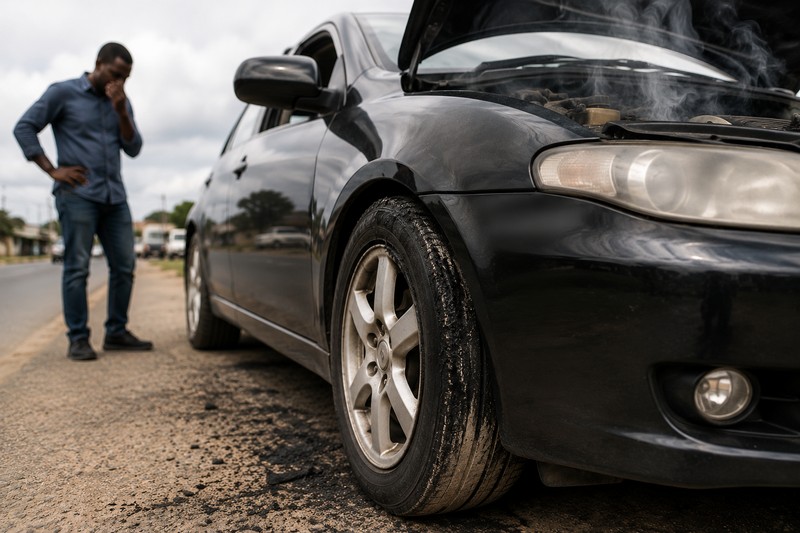
An oil or coolant leak that drips onto a hot exhaust manifold, turbocharger or exhaust pipe produces a burning smell that can closely resemble burning rubber. The smell is strongest immediately after switching off the engine when hot components are cooling, and often after extended driving in slow Nairobi traffic where the engine runs particularly hot. You may also see faint wisps of smoke from the engine bay after parking.
This type of burning smell indicates both an oil or coolant leak — which needs fixing — and a potential fire risk if the leak is significant and the exhaust components are very hot. Check your oil and coolant levels immediately. A drip onto a hot turbocharger is particularly dangerous as turbos run at extreme temperatures. Find an engine specialist to locate and repair the leak.
6. Plastic Bag or Foreign Object on the Exhaust
This is extremely common in Kenya and often the simplest explanation. Nairobi's roads and markets are littered with plastic bags and debris. A plastic bag that gets caught on the exhaust pipe or catalytic converter melts almost immediately, producing an intense burning smell that many drivers mistake for a serious mechanical problem. The smell is typically very strong for a few minutes and then fades as the material burns off completely.
If a strong burning smell appears suddenly and then fades within 2–5 minutes of driving, a plastic bag or debris on the exhaust is the most likely cause — particularly if you have recently driven through a market area, flooded road or debris-strewn section of Nairobi. Pull over briefly and visually inspect under the car before assuming a mechanical fault.
7. New Brake Pads Bedding In
If your brakes were recently replaced and you are noticing a burning smell for the first few days of driving, this is often normal and expected. New brake pads contain resins and bonding agents in the friction material that need to cure at operating temperature — a process called bedding in. During this process, particularly under moderate to firm braking, these compounds burn off and produce a smell that resembles burning rubber.
The bedding-in smell typically disappears within the first 200–500 km after a brake pad replacement. If the smell persists beyond this or is accompanied by unusual noises or reduced braking effectiveness, return to the garage — the pads may have been incorrectly installed or the wrong specification used for your vehicle.
Is It Safe to Keep Driving?
| Smell Source | Risk Level | Action |
|---|---|---|
| Plastic bag on exhaust — fades quickly | Low | Pull over briefly, check and continue |
| New brake pads bedding in | Low | Normal — clears within 200–500 km |
| Clutch hot after difficult traffic | Low | Normal if occasional — fix riding habit |
| Slipping drive belt | Medium | Book repair within a few days — belt can snap |
| Oil or coolant leak onto exhaust | Medium | Check levels, fix leak promptly |
| Dragging brake caliper | Urgent | Inspect today — safety and fire risk |
| Clutch slipping on flat roads | Urgent | Book repair — clutch deteriorating fast |
| Burning electrical / plastic smell | Stop Now | Pull over immediately — fire risk |
Repair Costs in Kenya (2025)
| Repair / Service | Est. Cost (Ksh) | Severity | Notes |
|---|---|---|---|
| Brake caliper rebuild | 3,000 – 8,000 | Urgent | Per caliper — do not delay a dragging caliper |
| Brake pad replacement (per axle) | 3,000 – 10,000 | Medium | Replace in pairs — both sides of the axle |
| Drive belt replacement | 1,500 – 5,000 | Medium | Replace all belts at once — labour is shared |
| Full clutch replacement | 15,000 – 45,000 | Medium | Disc, pressure plate and bearing together |
| Oil leak repair | 2,000 – 25,000 | Medium | Cost depends on source of leak |
| Electrical diagnosis and repair | 2,000 – 15,000 | Urgent | Do not drive with an electrical burning smell |
Prevention Tips
- Do not ride the clutch in Nairobi traffic. Use neutral and the brake when stationary — the clutch should only be pressed when changing gear or moving away. This is the single most effective way to prevent clutch burning smells in Kenya.
- Use engine braking on long descents. Drop a gear on the escarpment road and other long downhill sections rather than riding the brakes continuously. This prevents brake overheating and the burning smell that comes with it.
- Have brake calipers inspected every 20,000–30,000 km. A partially seized caliper that is caught early is a Ksh 3,000–5,000 repair. Left until the pad burns through, it becomes a Ksh 15,000+ job including disc replacement. Find a brake specialist for inspection.
- Check drive belts at every major service. A glazed or cracked belt visible during inspection costs Ksh 1,500–3,000 to replace proactively. A belt that snaps while driving can damage other components and leave you stranded on Mombasa Road or the highway.
- Fix oil and coolant leaks promptly. A small drip that reaches the exhaust becomes a significant burning smell and a fire risk over time. Address any oil or coolant leak as soon as it is detected. Find an engine specialist to locate the source.
- Have your electrical system inspected annually. Aftermarket alarms, trackers and audio systems fitted by roadside installers in Kenya are a frequent source of overloaded wiring. An annual electrical inspection by an auto electrician catches dangerous wiring before it becomes a fire risk.
Find a Trusted Mechanic Near You
Search 400+ verified garages across Nairobi and Kenya on FixMyCar. Get your burning smell diagnosed properly before it becomes a bigger problem.
Find a Garage Now →Free to search · No booking fees · 400+ garages listed