What Is Normal on a Cold Start?
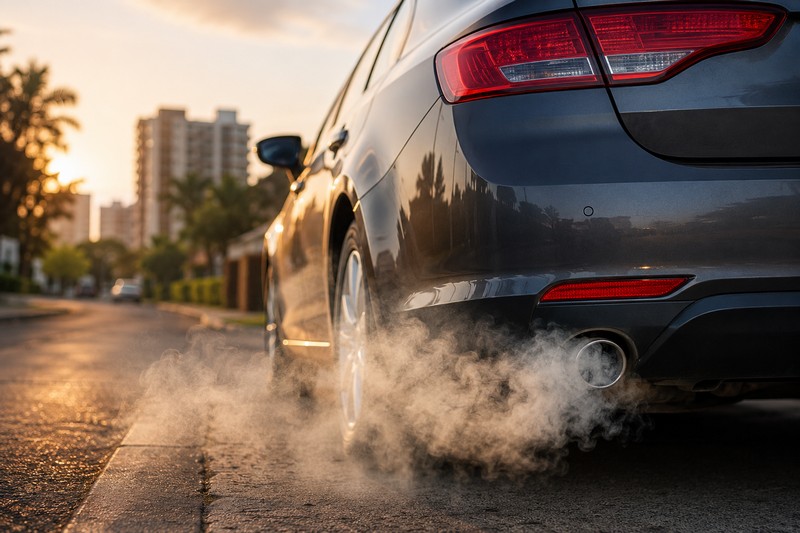
Before worrying about smoke, it helps to know what is entirely normal. On a cold morning — particularly in Nairobi's highland areas like Karen, Gigiri, Runda or the outskirts towards Limuru — it is completely normal to see a small amount of white water vapour from the exhaust for the first 1–3 minutes of running. This is simply condensation inside the exhaust system burning off as the exhaust heats up. It disappears quickly and has no smell.
This normal condensation is most visible on cool mornings and is not a cause for concern. The smoke worth investigating is smoke that persists after the engine has fully warmed up, or smoke with a noticeable colour and smell from the very first start. The guide below covers each type.
Blue Smoke: Oil Is Burning in the Engine
Blue or blue-grey smoke from the exhaust means engine oil is entering the combustion chamber and burning alongside the fuel. Oil should never be in the combustion chamber — its presence there means something has failed that is allowing it to pass from the lubrication system into the cylinders.
Blue smoke on startup that clears after a few minutes
This pattern — a puff of blue smoke when the engine is first started, which disappears after warming up — is usually caused by worn valve stem seals. These are small rubber seals around the valve stems in the cylinder head. When they harden and crack with age, oil seeps down the valve guides overnight as the engine sits. When you start the car, this pooled oil burns immediately, producing the blue puff. Once the engine is running and oil pressure builds normally, no more oil enters and the smoke stops.
Valve stem seal replacement is a moderately significant repair requiring cylinder head work, costing Ksh 15,000–40,000 in Nairobi depending on the engine. It is not an emergency but should be planned — oil loss through this route is slow but continuous.
Blue smoke continuously while driving
Continuous blue smoke under acceleration or throughout normal driving points to worn piston rings. The piston rings seal the combustion chamber from the crankcase below. When they wear — which happens faster in high-mileage engines, particularly those that have frequently run low on oil — they allow oil to enter the combustion chamber from below and burn continuously. This is accompanied by gradually increasing oil consumption and a persistent blue haze in the exhaust.
Worn piston rings are a serious issue requiring engine rebuild or replacement. In Kenya, an engine rebuild on a Toyota or Subaru typically costs Ksh 60,000–150,000. Continuing to drive significantly accelerates the damage and oil consumption — check your oil level every few days if this symptom is present. Find an engine specialist for assessment.
Oil burning in the combustion chamber coats and damages the catalytic converter over time, eventually requiring replacement (Ksh 25,000–80,000). If you have blue smoke, address the oil burning cause before the converter is destroyed — otherwise you face two expensive repairs instead of one.
Blue smoke from a turbocharged engine
On turbocharged vehicles — Subaru, newer Toyota Hilux, some European vehicles common in Nairobi — blue smoke can also indicate worn turbocharger seals allowing oil to enter the intake or exhaust side of the turbo. This requires turbocharger inspection and likely rebuild or replacement, costing Ksh 15,000–150,000 depending on severity. Subaru owners in Kenya should be particularly attentive to this — the EJ-series engines are known for turbo seal issues when oil changes are delayed.
White Smoke: Coolant or Water Is Burning
Thick white smoke with a sweet smell — different from the odourless water vapour of normal cold-start condensation — means coolant is entering the combustion chamber and burning. This is a serious symptom that almost always indicates a blown head gasket, a cracked cylinder head, or in severe cases a cracked engine block.
How to tell normal condensation from a real white smoke problem
- Normal condensation: Disappears within 2–3 minutes of the engine warming up. No smell. Only on cold mornings.
- Coolant burning: Persists after the engine is fully warm. Has a distinctly sweet smell. May also be accompanied by the engine running rough, the coolant level dropping regularly, or a milky/frothy appearance in the oil (check the underside of the oil filler cap).
Head gasket failure
A blown head gasket is the most common cause of white smoke on Kenyan vehicles. The head gasket seals the cylinder head to the engine block and keeps coolant and oil separate from the combustion chambers. When it fails — usually as a consequence of previous overheating, often caused by Nairobi traffic heat — coolant enters one or more cylinders and burns, producing thick sweet white smoke.
Other signs of head gasket failure alongside white smoke: coolant level dropping without any visible external leak, bubbles in the coolant reservoir, the engine overheating repeatedly, and white frothy residue on the underside of the oil filler cap (a mixture of oil and coolant). Head gasket replacement in Kenya costs Ksh 50,000–200,000 depending on the engine type and extent of additional damage from overheating.
Remove your engine oil filler cap and look at its underside. If you see a creamy, mayonnaise-like residue, coolant is mixing with your engine oil — a strong sign of head gasket failure. This residue can also appear on the dipstick. Do not drive further if you see this — coolant in the oil destroys engine bearings rapidly.
Cracked cylinder head
Less common but more serious, a cracked cylinder head allows coolant into the combustion chamber directly. This produces similar symptoms to a blown head gasket but the repair is more complex — the cylinder head must be replaced or professionally welded, costing Ksh 30,000–100,000 for the head work alone, plus gasket and assembly costs. Cylinder head cracks are most often caused by severe overheating — running the engine with insufficient coolant or continuing to drive when the temperature gauge is in the red.
Black Smoke: Too Much Fuel Is Burning
Black smoke from the exhaust means the engine is running too rich — burning more fuel than it should relative to the air available. Unlike blue and white smoke, black smoke is not usually caused by a catastrophic mechanical failure, but it does indicate a fuel system, air intake, or engine management problem that is wasting fuel and should be repaired.
Black smoke on petrol engines
On petrol vehicles, black smoke is less common than on diesel and usually points to a faulty fuel injector delivering too much fuel, a failed oxygen sensor causing the ECU to over-fuel, a severely blocked air filter starving the engine of air, or a stuck-open fuel pressure regulator. The check engine light is often on alongside black smoke on petrol engines — a diagnostic scan will identify the specific fault code quickly.
Black smoke on diesel engines
Black smoke is more common on diesel vehicles and is a very frequent complaint in Kenya, particularly on older diesel pickups, Land Cruisers, and Isuzu trucks. On acceleration, a small puff of black smoke is normal on older diesel engines under load. Persistent heavy black smoke indicates worn fuel injectors delivering too much fuel or incorrect spray pattern, a blocked air filter or a blocked turbo intake restricting airflow, a faulty EGR valve stuck open, or in turbodiesels, a failing or damaged turbocharger not providing sufficient boost pressure.
Black smoke on diesel vehicles significantly increases fuel consumption and accelerates engine wear. Injector testing and cleaning or replacement (Ksh 10,000–40,000), air filter replacement (Ksh 500–2,000), and EGR valve service (Ksh 2,000–25,000) are the most common fixes. Find a fuel system specialist for diesel injector work.
Repair Costs in Kenya (2025)
| Smoke Type / Cause | Est. Cost (Ksh) | Urgency | Notes |
|---|---|---|---|
| Valve stem seal replacement | 15,000 – 40,000 | Medium | Blue puff on startup — plan repair within months |
| Piston ring replacement / engine rebuild | 60,000 – 150,000 | High | Continuous blue smoke — serious internal wear |
| Turbocharger rebuild / replacement | 15,000 – 150,000 | High | Blue smoke on turbo vehicles — inspect promptly |
| Head gasket replacement | 50,000 – 200,000 | Urgent | White smoke with sweet smell — do not delay |
| Cylinder head repair / replacement | 30,000 – 100,000 | Urgent | Often caused by previous severe overheating |
| Fuel injector clean / replace (petrol) | 3,000 – 20,000 | Medium | Black smoke on petrol — clean before replacing |
| Diesel injector service / replace | 10,000 – 40,000 | Medium | Heavy black smoke on diesel — injectors first |
| Air filter replacement | 500 – 2,000 | Low | Always check this first for black smoke |
Prevention Tips
- Never let your engine overheat. The majority of serious white smoke problems — blown head gaskets and cracked cylinder heads — are caused by previous overheating incidents. Act immediately when the temperature gauge rises above normal, especially in Nairobi traffic. See our guide on engine repairs if overheating is a recurring issue.
- Change your engine oil on schedule. Oil-burning problems are significantly more common in engines that have been run with old, degraded oil or that have repeatedly run low on oil. Change every 5,000–7,500 km for conventional oil or 10,000 km for full synthetic.
- Use the correct oil grade. Thin oil on a worn engine increases oil consumption and accelerates piston ring and valve seal wear. Check your owner's manual for the specified viscosity and confirm it at your next oil service.
- Replace your air filter every 15,000–20,000 km in Kenya. A clogged air filter is one of the easiest causes of black smoke to prevent. In dusty Kenyan conditions, filters clog significantly faster than the manufacturer's interval suggests.
- Service your cooling system every two years. Fresh coolant, a functional thermostat and a clean radiator are the best protection against the overheating that leads to head gasket failure and white smoke. Book a cooling system service through fixmycar.ke.
- Have your engine inspected annually. A mechanic checking for early signs of valve seal wear, coolant consumption and injector condition at a routine service can catch problems before they produce visible smoke.
Find an Engine Specialist Near You
Search verified engine repair specialists and garages across Nairobi and Kenya on FixMyCar. Get your smoke problem diagnosed correctly the first time.
Find a Specialist Near You →Free to search · No booking fees · 400+ garages listed