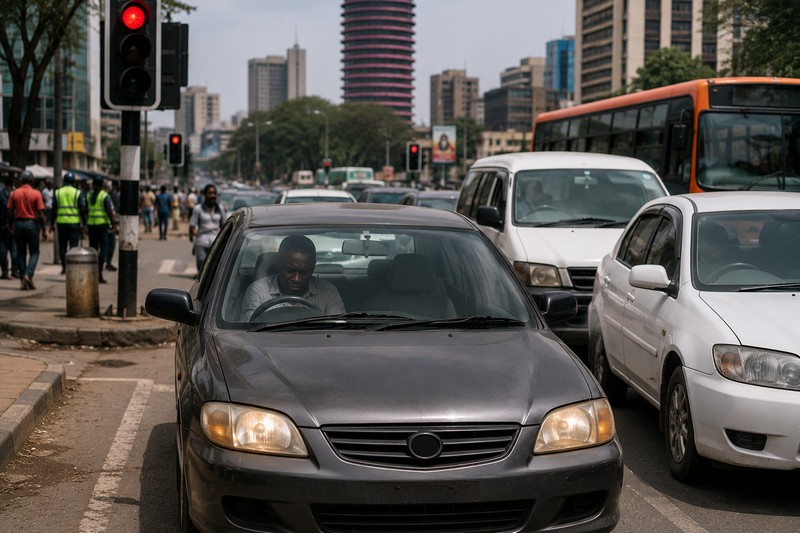
What Stalling at Idle Tells You
When a car stalls at traffic lights, it means the engine cannot maintain sufficient power to keep itself running without throttle input. At idle — when you are stopped at a junction with your foot off the accelerator — the engine must sustain its own operation on a small, precisely calibrated fuel-air mixture. Any disruption to this mixture, any additional load that the engine cannot handle, or any fuel delivery problem causes the engine to drop below the minimum rpm needed to keep running — and it stalls.
In Nairobi's conditions, stalling at traffic lights is particularly common because the additional load of the AC compressor, a hot engine in slow traffic, and degraded maintenance items all combine. An engine that runs well on the open highway but stalls repeatedly in the city is almost always a maintenance problem that has been masked by higher engine speeds when driving.
Note these patterns before visiting a garage — they point to very different causes:
- Stalls only when the AC is switched on: The AC compressor adds load the engine cannot handle at idle — weak spark plugs, dirty IAC valve or a vacuum leak are common causes.
- Stalls when coming to a stop — engine drops and dies: Idle control valve, throttle body carbon buildup, or a vacuum leak causing the idle to be too low.
- Stalls after the engine has been running for 20–30 minutes and is hot: A heat-sensitive fault — failing crankshaft position sensor, a fuel system problem, or a coil that breaks down when hot.
- Stalls only on cold start, fine when warm: Idle speed calibration, dirty IAC valve, or a minor vacuum leak that seals as components expand with heat.
- Stalls with a check engine light on: Diagnose with a scanner first — the fault code will identify the problem directly.
7 Most Common Causes in Kenya
1. Dirty or Faulty Idle Air Control (IAC) Valve
The idle air control valve is the most common cause of stalling at traffic lights on the Japanese vehicles that dominate Kenya's roads. The IAC valve regulates the amount of air bypassing the throttle body to maintain a stable idle speed — typically 700–900 rpm. In Nairobi's slow traffic, the engine spends hours at idle and the IAC valve accumulates carbon deposits from recirculated exhaust gases and oil vapour in the intake. As deposits build up, the valve cannot respond quickly enough when the engine drops in rpm at a stop — and the engine stalls.
IAC valve problems are particularly common on the Toyota Corolla 1ZZ engine, Nissan Tiida, and Mazda Demio — all very common vehicles in Nairobi. Cleaning the IAC valve with carb cleaner (Ksh 1,000–2,500 at a garage) resolves the stalling in many cases without replacement. If the valve has failed electronically, replacement costs Ksh 3,000–8,000. Find an engine specialist near you.
When the car is about to stall at a traffic light, try blipping the throttle very briefly — just a tap of the accelerator. If this prevents the stall and the car recovers, the IAC valve is almost certainly the problem. It cannot maintain idle on its own but responds when you manually increase the air-fuel supply. This tells the mechanic exactly where to look.
2. Dirty Throttle Body
The throttle body controls the main air supply to the engine. Over time — and faster in Nairobi's dusty, congested conditions — carbon deposits build up on the throttle plate and bore, reducing airflow and disrupting the precisely calibrated idle mixture. A throttle body with significant carbon buildup causes rough idle, stalling at stops, and hesitation when pulling away from junctions.
Throttle body cleaning is a straightforward service — a mechanic removes the throttle body, cleans the plate and bore with carb cleaner and a soft brush, and reinstalls it. On drive-by-wire vehicles (most cars made after 2005), the throttle body must be recalibrated with a diagnostic tool after cleaning — a step that many budget roadside garages skip, causing the idle to be unstable after the cleaning. Throttle body cleaning costs Ksh 1,500–4,000 at a reputable garage and should be done every 40,000–60,000 km.
3. Vacuum Leak
A vacuum leak — a crack or disconnection in any of the rubber vacuum hoses throughout the engine bay — allows unmetered air to enter the intake manifold, disrupting the fuel-air mixture at idle. The engine management system can partially compensate for small leaks when driving at higher rpm, but at the very low airflow rates of idle, even a small vacuum leak can cause rough running and stalling.
Vacuum leaks are particularly common on Kenyan vehicles over 8–10 years old because the heat of equatorial conditions ages rubber hoses faster than in temperate climates. A typical Japanese import in Nairobi that is 10+ years old has rubber vacuum hoses that are well past their service life. Identifying a vacuum leak requires either a smoke test (Ksh 1,500–3,000) or the careful use of carb cleaner around hose connections with the engine running — a change in idle speed when spray reaches the leak location confirms its position. Hose replacement costs Ksh 500–3,000.
4. Worn Spark Plugs or Failing Ignition Coil
Worn spark plugs or a failing ignition coil cause misfires — incomplete combustion in one or more cylinders. At highway speeds, the engine has enough momentum and the other cylinders compensate well enough that the misfire may not be noticeable. At idle — where engine rpm is low and each cylinder's contribution is more critical — a misfiring cylinder drops the engine rpm enough to cause stalling, particularly when additional load from the AC is added.
On the Toyota Corolla with the 1ZZ-FE engine — one of the most common cars in Nairobi — individual ignition coil failure is extremely common and causes exactly this symptom: runs fine on the highway, stalls at traffic lights. A diagnostic scan identifies the misfiring cylinder with a P030X fault code immediately. Spark plug replacement costs Ksh 1,500–5,000 for a full set. Individual coil replacement costs Ksh 3,000–8,000. Always replace spark plugs at the same time as a coil — old plugs put extra strain on new coils.
5. Fuel Delivery Problem
A weakening fuel pump, a clogged fuel filter, or a failing fuel pressure regulator can cause stalling that is more pronounced at idle where fuel demand is lowest — counterintuitively, a weak pump that cannot maintain adequate pressure causes the engine to stall when the throttle is closed and the injector pulse width is at its minimum. The stall may be preceded by rough running or hesitation in the final few seconds before the engine dies.
Fuel delivery problems are more common in Kenya on vehicles that have frequently used fuel from substandard stations — contaminated fuel accelerates fuel filter clogging and can damage fuel pump internals over time. A fuel pressure test at a garage (Ksh 500–1,500) confirms whether the pump is delivering the correct pressure. Fuel filter replacement costs Ksh 1,500–4,000. Fuel pump replacement costs Ksh 8,000–25,000. Find a fuel system specialist for testing.
6. Failing Crankshaft Position Sensor
The crankshaft position sensor monitors the position and speed of the crankshaft and sends this data to the ECU — which uses it to control ignition timing and fuel injection. When this sensor begins to fail, the ECU loses the signal it needs to fire the injectors and ignition system at the correct moment, causing the engine to stall suddenly — sometimes with no warning at all. A failing crankshaft position sensor typically causes stalling that is intermittent at first, becoming more frequent over days or weeks.
The characteristic pattern of a failing crankshaft position sensor is stalling when the engine is at a specific temperature — often after it has been running for 20–30 minutes and reached full operating temperature. The car may restart immediately or may require waiting several minutes for the sensor to cool down before it works again. This heat-dependent failure pattern is the key diagnostic clue. Sensor replacement in Nairobi costs Ksh 3,000–8,000. A diagnostic scan may or may not show a fault code depending on whether the sensor has failed completely or is intermittent.
7. Low or Fluctuating Battery Voltage
A weak battery or failing alternator that produces fluctuating voltage can cause stalling at idle on modern electronically managed engines. The ECU and fuel injectors require stable voltage to operate correctly. When battery voltage drops — particularly when the AC compressor, rear defrost and headlights are all running simultaneously in Nairobi's evening traffic — the ECU may reset or malfunction, causing a sudden stall. This is more common on vehicles where the battery is old or where the alternator is beginning to fail.
If your stalling is accompanied by flickering dashboard lights, a battery warning light, or other electrical symptoms, have the charging system tested first before investigating other causes. An alternator and battery test at a Nairobi garage takes 5 minutes and costs nothing or Ksh 200–500. Alternator replacement costs Ksh 8,000–25,000. Find an electrical specialist near you.
How to Diagnose the Problem
-
Check for a check engine lightIf the check engine light is on, a diagnostic scan (Ksh 500–2,000) is the single fastest route to diagnosis. Misfire codes (P030X), IAC codes, MAF sensor codes and crankshaft sensor codes all appear immediately and tell the mechanic exactly where to look. Find a diagnostic specialist near you.
-
Note exactly when the stalling occursOnly with AC on? Only when hot? Only at certain junctions? Only in the morning? Each pattern is a strong diagnostic clue. The more specific your description, the faster and cheaper the diagnosis at the garage.
-
Try the throttle blip testWhen the car is about to stall, briefly tap the accelerator. If this prevents the stall, the IAC valve or throttle body is the likely cause — the engine cannot maintain idle on its own. If the car stalls regardless of throttle input, a fuel or sensor problem is more likely.
-
Check spark plug and coil conditionIf the car has not had a spark plug service in the last 30,000 km, replacing the full set (Ksh 1,500–5,000) is a logical first step. Old or fouled plugs cause the majority of stalling complaints on Kenya's ageing Japanese vehicle fleet — particularly at idle when each cylinder's contribution matters most.
-
Have IAC valve and throttle body cleanedIf spark plugs are in good condition, IAC valve and throttle body cleaning (Ksh 1,500–4,000 combined) is the next logical step — it resolves the majority of remaining stalling complaints on Nairobi's Japanese vehicle fleet. Find a trusted mechanic on fixmycar.ke.
Repair Costs in Kenya (2025)
| Cause / Fix | Est. Cost (Ksh) | Severity | Notes |
|---|---|---|---|
| Diagnostic scan (OBD) | 500 – 2,000 | First Step | Always do this first if check engine light is on |
| IAC valve cleaning | 1,000 – 2,500 | Low | Resolves most stalling complaints on Japanese vehicles |
| IAC valve replacement | 3,000 – 8,000 | Medium | If cleaning does not resolve the problem |
| Throttle body cleaning | 1,500 – 4,000 | Low | Must be recalibrated after on drive-by-wire vehicles |
| Spark plug replacement (full set) | 1,500 – 5,000 | Low | Replace all plugs at once — never just one |
| Ignition coil replacement | 3,000 – 8,000 | Medium | Very common on Toyota Corolla 1ZZ in Kenya |
| Vacuum hose replacement | 500 – 3,000 | Low | Check all hoses while you are there |
| Fuel filter replacement | 1,500 – 4,000 | Medium | Do every 40,000 km regardless of symptoms |
| Crankshaft position sensor | 3,000 – 8,000 | Medium | Suspect if stalling is heat-dependent and intermittent |
| Fuel pump replacement | 8,000 – 25,000 | High | Test fuel pressure first before replacing |
Prevention Tips
- Replace spark plugs every 30,000 km in Kenya. Nairobi's slow traffic causes carbon fouling much faster than highway driving. Fresh plugs at 30,000 km intervals are one of the cheapest and most effective ways to prevent stalling — and improve fuel economy at the same time.
- Have your IAC valve and throttle body cleaned every 40,000–60,000 km. In Nairobi's congested conditions, carbon buildup on these components is faster than the manufacturer's schedule anticipates. Including this in your major service prevents the majority of city stalling problems before they develop.
- Use fuel from major branded stations. Contaminated fuel from substandard stations accelerates fuel filter clogging and damages fuel pump internals. Fill up at Shell, Total, Rubis or Kenol — particularly for vehicles used mainly in the city where fuel quality variation has the most impact.
- Replace your fuel filter every 40,000 km. A partially clogged filter is a common contributor to stalling that is easy and cheap to prevent. Have it changed as part of your routine general maintenance service.
- Have your charging system tested annually. A weak battery or failing alternator can cause stalling on modern electronically managed engines. Annual testing catches these before they cause problems in Nairobi traffic.
- Do not ignore a check engine light. Many stalling problems in Kenya have specific fault codes stored in the ECU that make diagnosis fast and cheap. A car that stalls occasionally and has a check engine light is communicating the problem directly — a Ksh 500–2,000 scan may solve what would otherwise be weeks of intermittent frustration.
Find a Mechanic Near You in Nairobi
Search 400+ verified garages across Nairobi and Kenya on FixMyCar. Get your stalling problem diagnosed and fixed properly.
Find a Garage Now →Free to search · No booking fees · 400+ garages listed