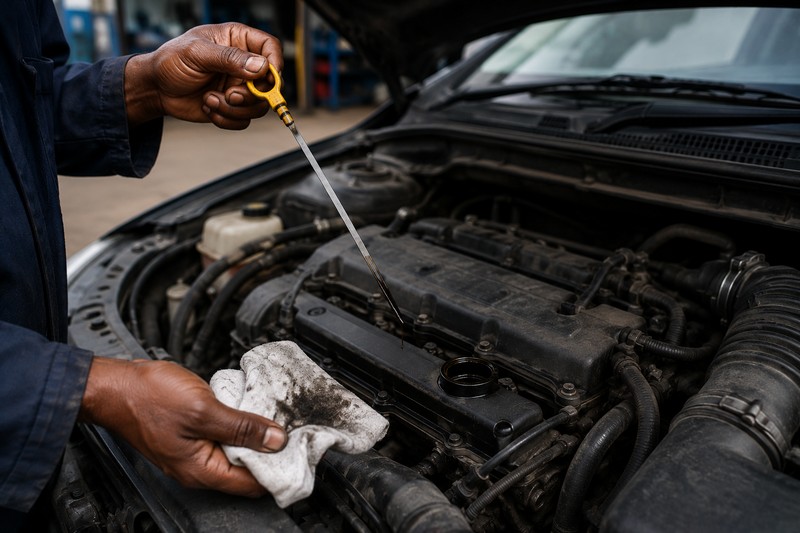
How to Measure Your Oil Consumption
Before visiting a garage, establish your actual oil consumption rate accurately. This gives the mechanic a baseline and helps confirm the problem is genuine rather than a one-off top-up that was missed.
-
Change the oil and fill to the MAX markStart from a known full level. Use a fresh oil change or simply top up to the MAX mark on the dipstick. Note the date and mileage.
-
Drive 1,000 km without topping upDrive normally for 1,000 km — a mix of city and highway driving. Do not add any oil during this period regardless of the level.
-
Check the dipstick and measure the dropAfter exactly 1,000 km, check the dipstick. Each mark on most dipsticks represents approximately 0.5–1 litre depending on the vehicle. Note how far the level has dropped from MAX.
-
Compare against the acceptable rangeLess than 1 litre per 1,000 km = acceptable on older engines. 1–2 litres per 1,000 km = investigate promptly. More than 2 litres per 1,000 km = serious problem needing immediate attention.
6 Most Common Causes in Kenya
1. External Oil Leak
The most straightforward cause of high oil consumption is an external leak — oil escaping from gaskets, seals or the oil pan. This is the first thing to check because it is the most visible and often the cheapest to fix. Common leak points on Kenya's ageing vehicle fleet include the oil pan gasket, valve cover gasket, crankshaft front or rear seals, and the oil filter or drain plug after a recent oil change.
To confirm an external leak, park on clean concrete overnight and check for an oil patch in the morning. Clean the entire engine with degreaser, then check again after 200–300 km of driving — fresh oil will show exactly where it is coming from. Even a slow leak that leaves no visible puddle can consume 1–2 litres per 1,000 km if the oil drips onto hot exhaust components and burns off immediately rather than pooling on the ground.
Gasket and seal replacement costs Ksh 2,000–25,000 depending on the location and complexity. See our full guide on oil leaks for specific causes and repair costs. Find an engine specialist to locate and repair the source.
Clean the entire engine bay with degreaser and a pressure rinse — most Nairobi car washes will do this for Ksh 200–500. Drive normally for 3–5 days then inspect the engine carefully. Fresh oil on a clean engine shows exactly where the leak originates — no guesswork, no expensive diagnostic tools required.
2. Worn Piston Rings
Piston rings seal the gap between the piston and the cylinder wall, preventing engine oil in the crankcase from entering the combustion chamber. As piston rings wear over high mileage — which accelerates in Kenya on engines that have been run low on oil or that have used degraded oil for extended periods — oil passes the rings and burns in the combustion chamber alongside the fuel.
The diagnostic signs of worn piston rings are very specific: blue or blue-grey smoke from the exhaust, most visible on acceleration when combustion pressure is highest and oil is pushed past the rings most forcefully. The smoke is continuous rather than only on startup. Oil consumption is typically high — 2 litres or more per 1,000 km in severe cases. A compression test and a leak-down test confirm worn rings definitively. This is a serious internal engine problem requiring engine rebuild or replacement — costs Ksh 60,000–150,000 on most Japanese vehicles.
3. Worn Valve Stem Seals
Valve stem seals are small rubber seals around each valve stem in the cylinder head. They prevent engine oil from the valvetrain area above from flowing down the valve guides into the combustion chamber. When these seals harden and crack with age and heat — which happens faster in Kenya's equatorial conditions — oil seeps down during the periods the engine sits switched off.
The characteristic symptom of worn valve stem seals is a puff of blue smoke specifically on cold startup — most visible on Nairobi's cooler highland mornings — that disappears after the engine has run for a few minutes. The smoke occurs because oil that has accumulated overnight on the valves burns off on the first few combustion cycles. Between cold starts, the engine may run cleanly with minimal smoke. Oil consumption is typically moderate — 0.5–1.5 litres per 1,000 km. Valve stem seal replacement is a significant but worthwhile repair costing Ksh 15,000–40,000 in Nairobi.
4. Positive Crankcase Ventilation (PCV) Valve Failure
The PCV valve controls the flow of crankcase gases back into the intake manifold for combustion rather than venting them to the atmosphere. When the PCV valve sticks open or fails, it draws excessive oil vapour and oil mist from the crankcase into the intake — which then burns in the combustion chamber. PCV valve failure causes oil consumption without visible external leaks, sometimes with a slight blue tinge to the exhaust, and often with an oily residue inside the air intake hose.
The PCV valve is one of the cheapest and most overlooked maintenance items on Kenyan vehicles. A new PCV valve costs Ksh 200–800 and takes five minutes to replace. Despite this, many vehicles in Kenya have never had it changed. If your car is consuming oil without an obvious external leak or visible blue smoke, replacing the PCV valve is the logical first step — it costs almost nothing and rules out one of the common causes immediately.
5. Wrong Oil Grade or Overfilling
Using engine oil that is too thin for the engine — a lower viscosity than the manufacturer specifies — causes higher oil consumption because thin oil passes more easily past worn seals and rings. This is a common problem in Kenya because many roadside garages use a universal 20W-50 oil for everything, while many modern Japanese engines specify 5W-30 or 0W-20. Conversely, some garages use oil that is too thin. Always verify the oil grade with your owner's manual.
Overfilling the engine with oil — adding too much above the MAX mark — also causes high consumption. Excess oil is pressurised and forced past seals that would otherwise contain it, and the rotating crankshaft whips excess oil into a foam that is then drawn into the PCV system and burned. If your oil was recently changed and consumption started immediately after, check the level — it may have been overfilled. The correct level is between MIN and MAX on the dipstick, ideally at or near MAX but not above it.
6. Turbocharger Oil Consumption
On turbocharged vehicles — increasingly common in Kenya on Subaru models, newer Toyota Hilux variants and various European cars — the turbocharger is lubricated and cooled by engine oil. When the turbo's internal seals wear, oil enters the intake or exhaust side of the turbo and burns. This causes oil consumption without obvious external leaks and with blue or white-tinged smoke under acceleration or when the turbo is working hard.
Turbo seal wear is accelerated in Kenya by delayed oil changes — the turbo runs at extremely high temperatures and requires fresh, high-quality oil to keep its bearings and seals in good condition. A turbo that has been run on degraded oil, or a vehicle where the engine was switched off immediately after hard driving without a cool-down period, will develop seal wear faster. Turbocharger inspection, rebuild or replacement costs Ksh 15,000–150,000 depending on severity and vehicle. Find an engine specialist experienced with turbocharged vehicles.
External Leak vs Internal Consumption
Distinguishing between oil that is leaking externally and oil that is being burned internally is an important first step that guides the entire diagnosis and repair approach.
| Sign | External Leak | Internal Consumption |
|---|---|---|
| Oil puddle under car when parked | Yes | No |
| Blue smoke from exhaust | No | Yes |
| Oil residue on engine exterior | Yes | No |
| Burning smell from engine bay | Sometimes | Rarely |
| Oily residue in exhaust pipe | No | Yes |
| Oil level drops without visible leak | No | Yes |
Repair Costs in Kenya (2025)
| Cause / Repair | Est. Cost (Ksh) | Severity | Notes |
|---|---|---|---|
| PCV valve replacement | 200 – 800 | Low | Cheapest first step — do this before anything else |
| Oil pan gasket replacement | 2,000 – 6,000 | Low | Most common external leak on older Kenyan vehicles |
| Valve cover gasket replacement | 2,500 – 7,000 | Low | Check for burning smell from engine bay |
| Crankshaft seal replacement | 3,000 – 25,000 | Medium | Rear main seal requires gearbox removal — expensive |
| Valve stem seal replacement | 15,000 – 40,000 | Medium | Blue puff on cold startup — plan repair within months |
| Turbocharger rebuild / replacement | 15,000 – 150,000 | High | Turbo vehicles only — inspect promptly |
| Engine rebuild (worn piston rings) | 60,000 – 150,000 | High | Continuous blue smoke on acceleration — serious wear |
Prevention Tips
- Check your oil level every two weeks. Takes 60 seconds and is the single most important habit for engine protection in Kenya. Always check when the engine is cold and the car is on level ground for an accurate reading.
- Change your oil on schedule — every 5,000–7,500 km. Degraded oil loses its lubricating properties and becomes acidic, attacking seals and gaskets from the inside. Nairobi's slow traffic and heat accelerate oil degradation faster than the manufacturer's schedule assumes. Use the correct grade — check your owner's manual and confirm with your garage at every oil service.
- Replace the PCV valve every 40,000–60,000 km. This is a Ksh 200–800 item that most Kenyan drivers have never changed. A stuck-open PCV valve draws oil into the intake continuously — cheap to fix when caught early.
- Do not run the engine low on oil. Even one episode of running below the MIN mark causes permanent accelerated wear on piston rings, cylinder walls and valve seals. Check the level if the engine sounds noisier than usual — a tapping or clattering sound at idle is often the first sign of low oil.
- Allow turbocharged engines to cool down before switching off. After hard driving or climbing a hill, allow the engine to idle for 2–3 minutes before switching off. This lets coolant and oil continue circulating through the turbo until temperatures drop — preventing oil from baking onto turbo bearings and accelerating seal wear.
- Address oil leaks immediately. A small drip that burns off on the exhaust before leaving a puddle can consume significant oil invisibly. Fix leaks as soon as they are detected rather than just topping up. Find an engine specialist to locate the source.
Find an Engine Specialist Near You
Search 400+ verified mechanics and engine specialists across Nairobi and Kenya on FixMyCar. Get your oil consumption problem diagnosed properly.
Find a Specialist Near You →Free to search · No booking fees · 400+ garages listed