Signs Your Clutch Is Slipping
Clutch slipping is often gradual at first — easy to dismiss as the car feeling slightly different. These are the specific signs to watch for on Kenyan roads.
- Engine revs rise faster than road speed increases: The most definitive sign. You press the accelerator and the rev counter jumps upward, but the car accelerates more slowly than expected — like the engine is disconnected from the wheels momentarily. Most noticeable when accelerating hard from a junction or overtaking on the highway.
- Loss of power climbing hills: Nairobi's hilly terrain — Karen, Gigiri, the Ngong Hills road, the escarpment on the way to Nakuru — exposes clutch slip immediately. If the car struggles and the revs climb without equivalent forward motion on an incline, the clutch is slipping under load.
- Burning smell after driving in traffic: A hot, acrid burning smell from the transmission tunnel area after slow Nairobi traffic is a sign the clutch disc is overheating — either from slipping or from excessive riding.
- High clutch biting point: The clutch only begins to engage very near the top of pedal travel, with little room to release further. This indicates the friction material is worn thin — the pressure plate must release further to compensate.
- Difficulty accelerating normally: The car feels sluggish or hesitant from a standing start even when the engine is running well — the clutch cannot transfer full engine torque to the gearbox.
- Clutch slips only when cold, works fine when warm: This specific pattern often indicates oil contamination on the clutch disc rather than simple wear. Oil on the disc reduces friction when cold but the heat of driving burns it off temporarily.
What Causes Clutch Slipping in Kenya
Normal Wear — The Most Common Cause
The clutch disc is a wear item — like brake pads, it has a finite amount of friction material that reduces with use. Every time you engage the clutch from a standstill, accelerate through a gear change, or control speed on a steep hill, a small amount of friction material is consumed. In Kenya's conditions — where stop-start Nairobi traffic means dozens of clutch engagements per kilometre — clutch wear is significantly faster than the manufacturer's estimates based on European or Japanese driving patterns.
A clutch disc worn to its limits simply cannot generate enough clamping force to transfer full engine torque — it slips under load. This is the straightforward end-of-life scenario that requires a full clutch replacement.
Clutch Riding in Nairobi Traffic
One of the primary causes of premature clutch wear in Kenya is the habit of riding the clutch — keeping the foot partially on the clutch pedal while driving, or controlling the car's speed in slow traffic by slipping the clutch rather than using the brake. This generates enormous heat in the clutch disc and pressure plate over sustained periods, burning through friction material at many times the normal rate.
Nairobi's slow traffic creates strong temptation to ride the clutch — moving forward a few metres at a time, using partial clutch engagement to inch along. The correct technique is to select neutral and use the brake for stationary or near-stationary traffic, selecting first gear only when there is space to actually move forward. This single habit change extends clutch life dramatically.
In bumper-to-bumper traffic on Mombasa Road, Thika Road or Ngong Road, use neutral and the brake — not the clutch — to control your position. The clutch should only be pressed when you are about to move or change gear. Resting your foot on the clutch pedal even lightly keeps the release bearing in contact with the pressure plate and accelerates wear on both.
Oil Contamination
Engine oil or gearbox oil leaking onto the clutch disc dramatically reduces friction and causes slipping even on a disc that still has friction material remaining. Common leak sources include the rear main crankshaft seal (at the back of the engine, directly above the clutch), the gearbox input shaft seal, and on some vehicles the gearbox itself. Oil-contaminated clutch discs cannot be cleaned — the oil soaks into the friction material permanently. The leak source must be identified and repaired at the same time as the clutch is replaced, otherwise the new clutch will be contaminated within weeks.
Weak or Worn Pressure Plate Springs
The pressure plate uses strong diaphragm springs to clamp the clutch disc against the flywheel. Over time and with heat cycling, these springs can weaken or individual fingers can crack — reducing the clamping force on the disc. A clutch with a weakened pressure plate slips under load even if the disc still has friction material remaining. This requires pressure plate replacement — which is always done together with the disc as part of a complete clutch kit.
Incorrect Clutch Adjustment
On cable-operated clutch systems, incorrect free play adjustment can cause the clutch to slip without any actual wear. If the cable is adjusted too tight — leaving no free play at the pedal — the pressure plate is held in a slightly released position permanently, reducing clamping force and causing slip under load. This is a free adjustment that a mechanic can make in 15 minutes. Always check clutch cable adjustment before assuming a worn clutch on a vehicle that should not be worn yet.
How Long Can You Drive With a Slipping Clutch?
This depends on how severely it is slipping and what is causing it.
- Mild slip only under hard acceleration: You can continue driving carefully for a short time — 1–3 weeks — while arranging the repair. Avoid steep hills, heavy loads and aggressive acceleration. The clutch will continue to deteriorate.
- Slip on normal acceleration or on inclines: Plan the repair within days. Continuing to drive accelerates wear rapidly and risks being stranded.
- Slip most of the time, difficulty moving away: Do not drive further than necessary to reach a garage. The clutch is very near complete failure.
- Cannot move the car at all — clutch completely failed: The car needs towing. Do not attempt to drive it. Find a towing service and a transmission specialist on fixmycar.ke.
Every kilometre driven with a slipping clutch burns more friction material and generates heat that damages the flywheel and pressure plate. A Ksh 20,000 clutch disc replacement can become a Ksh 40,000 job including flywheel resurfacing if the clutch is driven to complete failure. Acting early is significantly cheaper.
Repair Costs in Kenya (2025)
Clutch replacement cost in Kenya varies significantly by vehicle make, the quality of parts used, and the garage. Japanese vehicles — Toyota, Subaru, Nissan, Mazda — have the widest parts availability and typically the most competitive labour rates in Nairobi.
| Vehicle / Repair | Est. Cost (Ksh) | Notes |
|---|---|---|
| Toyota Corolla / Fielder clutch kit | 15,000 – 28,000 | Most common clutch job in Nairobi — parts widely available |
| Subaru Impreza / Forester clutch kit | 20,000 – 40,000 | Subaru clutch labour is more intensive — more expensive |
| Nissan Tiida / X-Trail clutch kit | 18,000 – 32,000 | OEM parts preferred for Nissan in Kenya |
| Mazda Demio / Atenza clutch kit | 16,000 – 30,000 | Japanese parts widely available |
| Toyota Hilux / Land Cruiser clutch kit | 25,000 – 55,000 | Larger clutch — more expensive parts and labour |
| European vehicles (VW, BMW, Mercedes) | 35,000 – 90,000 | Parts more expensive and harder to source in Kenya |
| Flywheel resurfacing (additional) | 3,000 – 8,000 | Recommended if flywheel is scored or heat-damaged |
| Rear main seal replacement (additional) | 2,000 – 6,000 | Do this if there is any sign of oil leak — gearbox is already out |
What Gets Replaced During a Clutch Job
A proper clutch replacement involves three components — not just the disc. Understanding this helps you verify that the garage is doing the job correctly.
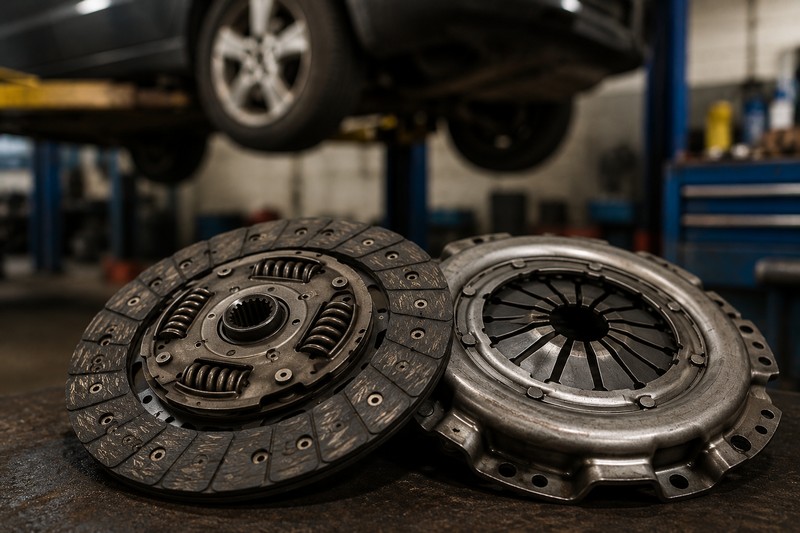
- Clutch disc (friction plate): The wear item that carries the friction material. This is what slips when worn.
- Pressure plate assembly: The spring-loaded plate that clamps the disc against the flywheel. Always replaced with the disc — a new disc against an old worn pressure plate will slip prematurely.
- Release bearing (clutch bearing): The bearing that presses against the pressure plate diaphragm fingers when the pedal is depressed. Always replaced — the labour to access it is shared with the clutch job and it wears at a similar rate.
At the same time, a reputable mechanic should also check and resurface or replace the flywheel if it is scored, cracked or heat-damaged. In Kenya, many budget clutch jobs skip the flywheel inspection — the new clutch then wears prematurely against a damaged flywheel surface. Always ask whether the flywheel has been inspected and what its condition is.
If there is any evidence of oil contamination — old oil staining on the clutch components — the source of the leak must be repaired at the same time. Since the gearbox is already removed for the clutch job, adding a rear main seal replacement costs very little additional labour (Ksh 2,000–6,000) compared to doing it as a separate job later.
How to Make Your Clutch Last Longer in Kenya
- Never ride the clutch in traffic. This is the single most damaging driving habit for clutch life in Nairobi. Use neutral and the brake when stationary or near-stationary — reserve the clutch for actual gear changes and moving away from stops.
- Do not rest your foot on the clutch pedal. Even light contact with the clutch pedal keeps the release bearing pressed against the pressure plate diaphragm, wearing both components continuously. Rest your foot on the footrest to the left of the clutch pedal between gear changes.
- Use the handbrake on hills — not the clutch. Holding position on a hill in Nairobi traffic using partial clutch engagement is extremely damaging. Apply the handbrake, select neutral, and only engage the clutch when you are ready to move forward. The hill start technique — handbrake, into first, find the biting point, release handbrake simultaneously — takes practice but saves thousands of shillings in clutch wear.
- Change gear at appropriate engine speeds. Forcing first-to-second gear changes at very low rpm — common in slow Nairobi traffic — causes the clutch to slip briefly during each change as the engine and gearbox speeds equalise. Slightly higher rpm gear changes are smoother on the clutch.
- Have the clutch cable or hydraulic system serviced regularly. A cable that is too tight or a hydraulic system with a partially failed slave cylinder keeps the clutch slightly disengaged permanently, burning friction material continuously. Have the system checked at every major service by a transmission specialist.
- Avoid overloading the vehicle. Heavy loads — full passenger loads plus luggage, overloaded pickup beds — increase the torque the clutch must transfer and accelerate wear significantly. Stay within the vehicle's stated payload capacity.
Find a Clutch Specialist Near You
Search verified transmission and clutch specialists across Nairobi and Kenya on FixMyCar. Get a proper diagnosis and competitive quote before authorising any work.
Find a Specialist Near You →Free to search · No booking fees · 400+ garages listed