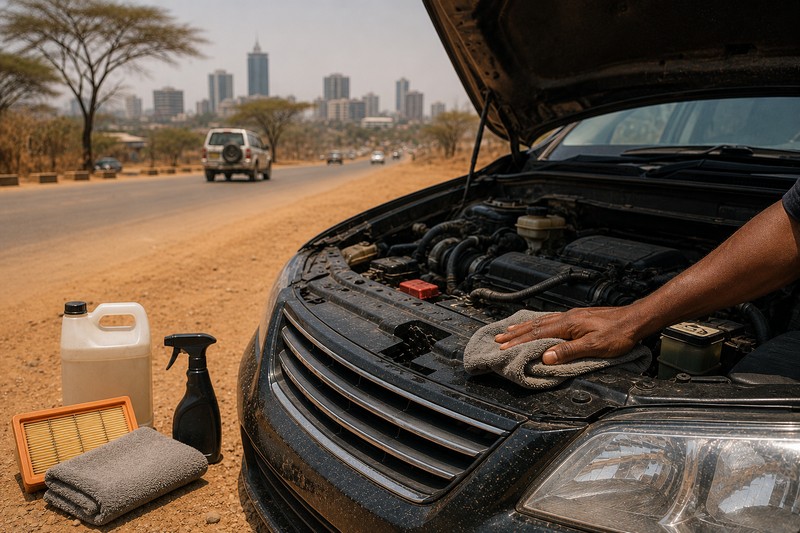
Why Dry Season Is Hard on Kenyan Cars
Kenya's dry season presents a combination of challenges that are different from — but no less damaging than — the rainy season. Understanding what specifically damages cars during dry months helps you prioritise the right maintenance.
- Extreme heat: Nairobi's dry season brings intense equatorial sun with minimal cloud cover. Interior temperatures in a parked car can reach 60–80°C — hot enough to damage rubber components, degrade interior plastics, and stress the battery significantly. Under-bonnet temperatures are even higher.
- Red murram dust: Kenya's signature red laterite dust penetrates everything. It clogs air filters dramatically faster than the manufacturer's schedule anticipates, enters cabin filters, coats brake discs, abrades paint surfaces and works into every unsealed gap in the vehicle. Vehicles driven on unpaved roads even occasionally accumulate remarkable quantities of this dust.
- UV radiation: Kenya sits on the equator — UV intensity here is significantly higher than in temperate countries where most vehicle maintenance schedules are written. Rubber seals, tyre sidewalls, wiper blades and exterior plastics all degrade faster than they would in Europe or Japan.
- Dry roads and dust reduce visibility: Following distance in dust clouds created by vehicles ahead on dry roads is a safety issue. Dust on headlights and taillights reduces their effectiveness significantly.
- Longer distances without rain washing: Dry season means extended periods without the natural cleaning effect of rain — salt from road surfaces, dust and grime accumulate on the underbody and in the engine bay.
Engine and Cooling System
The cooling system works harder during Kenya's dry season than at any other time of year. High ambient temperatures, slow Nairobi traffic and dusty conditions all combine to stress cooling components that may be marginal in cooler conditions.
Coolant Level and Condition
Check your coolant level every two weeks during the dry season — more frequently than at other times of year. High ambient temperatures increase coolant consumption through the overflow as the system reaches higher working pressures. A level that drops gradually is the first sign of a leak that the rains might have obscured through external washing effects.
If your coolant has not been flushed in the last two years, the dry season is an ideal time to do it. Old, degraded coolant loses its heat-transfer efficiency exactly when you need it most. A coolant flush costs Ksh 1,500–2,500 and should be followed by a refill with the correct 50/50 coolant-to-water mix — never plain water, which promotes internal corrosion and has a lower boiling point. Book a fluid service at a trusted garage.
Radiator Condition
Kenya's dry season roads — particularly murram sections and construction diversions — pack red dust and debris into the radiator fins with remarkable efficiency. A radiator that is 30% blocked by dust and debris loses significant cooling capacity. The effect is most noticeable in slow Nairobi traffic where airflow through the radiator depends entirely on the electric cooling fan rather than forward motion.
Inspect the radiator from the front every month during dry season. If the fins are visibly clogged with reddish dust, have the radiator cleaned — a low-pressure water rinse from behind the radiator (never high-pressure directly on the fins, which bends them) clears accumulated debris and restores cooling efficiency. Most Nairobi car washes will do an engine bay rinse including the radiator for Ksh 200–500.
Engine Oil
High ambient temperatures and extended periods of slow city traffic during the dry season are hard on engine oil. The oil works harder to maintain lubrication as temperatures climb, and degradation accelerates under sustained heat. If you are approaching your oil change interval during the dry season — within 1,000–1,500 km — do not push it. Change the oil and filter promptly and use the correct grade specified for your engine.
The dry season is also when checking oil level is most important. High operating temperatures increase oil consumption slightly, and oil levels that are adequate in cooler conditions can drop to the minimum mark faster. Check the dipstick every two weeks during dry months. Find a trusted garage for your oil service on fixmycar.ke.
Filters — The Most Neglected Dry Season Item
Kenya's red murram dust clogs air filters in a fraction of the manufacturer's recommended interval. A vehicle driven on unpaved roads even occasionally during the dry season may need its air filter replaced every 10,000–15,000 km rather than the standard 30,000 km. A clogged air filter is one of the easiest and cheapest causes of poor performance and high fuel consumption to fix — and one of the most commonly ignored.
Engine Air Filter
The engine air filter prevents dust, grit and debris from entering the engine's combustion chambers. A clogged filter restricts airflow, forces the engine to run rich (too much fuel, not enough air), reduces power, increases fuel consumption by up to 10–15%, and in extreme cases allows fine particles to bypass the filter and enter the engine — causing accelerated cylinder wear.
During Kenya's dry season — particularly if you drive on any unpaved roads — check the air filter monthly by removing it and tapping it against your palm. A cloud of red dust means it is approaching the end of its effective life. Replace it immediately if it is visibly clogged or discoloured deep into the filter material. Replacement costs Ksh 500–2,000 and is one of the best-value maintenance items on any Kenyan vehicle.
Cabin Air Filter
The cabin filter removes dust, pollen and particles from air entering the passenger compartment through the ventilation system. In Kenya's dry season, this filter captures enormous quantities of fine red dust — particularly on vehicles used in areas like Karen, Langata, Rongai or anywhere with murram road sections nearby. A blocked cabin filter reduces airflow from the AC and heater significantly, making the AC feel less effective even when the refrigerant level and compressor are both fine.
Many Kenyan drivers who complain that their AC is not as cold as it used to be actually have a clogged cabin filter — a Ksh 500–1,500 fix that immediately restores airflow. Replace the cabin filter every dry season at minimum, and more frequently if you drive on unpaved roads regularly. Find a garage for cabin filter replacement near you.
Fuel Filter
The fuel filter prevents contaminants from reaching the fuel injectors or carburettor. During the dry season, dust contamination of fuel — particularly at smaller stations where storage tanks may not be sealed as effectively — is a real issue in Kenya. A clogged fuel filter causes hard starting, rough running, reduced power and in severe cases engine stalling. Replace the fuel filter every 40,000 km or annually during a dry season service. Find a fuel system specialist near you.
Air Conditioning
The AC system works hardest during Kenya's dry season — cooling a car interior that has been sitting in 70°C+ heat, maintaining cabin temperature against intense solar radiation, and running continuously for hours in slow Nairobi traffic. This is the period when AC problems that were manageable in cooler months become intolerable — and when deferred AC maintenance becomes most expensive.
Pre-Dry-Season AC Service
Book an AC service at the start of the dry season — before temperatures peak in February–March and again in August–September. An AC service should include refrigerant level check, condenser cleaning, cabin filter replacement and a compressor function test. The full service costs Ksh 3,000–6,000 and ensures the system is running at full efficiency when you need it most.
Condenser Cleaning
The AC condenser — mounted in front of the radiator — accumulates red dust and insect debris during the dry season much faster than during the rains. A partially blocked condenser reduces AC effectiveness specifically in stationary traffic where there is no forward airflow to assist heat dispersal. Rinse the condenser gently from behind with a garden hose — never with a high-pressure jet which bends the delicate fins — whenever the AC seems less effective than usual. Find an AC specialist for a professional condenser service.
Parking in Shade
The single most effective way to protect your AC system during dry season is to park in shade whenever possible. A car parked in direct Nairobi sun reaches 70°C+ internally — when you then switch on the AC, the compressor must work at maximum output against this enormous heat load immediately. This constant maximum-demand cycling accelerates compressor wear significantly. Shade parking — under a tree, in a covered car park, or with a windscreen sun shade — reduces interior temperature by 20–30°C and dramatically extends compressor life.
Tyres and Brakes
Tyre Pressure and Heat
Tyre pressure increases as temperature rises — approximately 1 PSI for every 10°C increase in ambient temperature. During Kenya's dry season, a tyre that was correctly inflated on a cool morning will be over-inflated by mid-afternoon in the sun. This is not a significant safety concern in itself — the recommended pressures account for normal operating temperature increases. However, a tyre that is already at the maximum recommended pressure when cold may become dangerously over-inflated in the heat.
Check tyre pressure in the morning before the first drive of the day — when the tyres are cold — and set to the manufacturer's recommendation. Never let air out of a warm tyre to reach the recommended pressure — the reading will be incorrect once it cools. Check pressure monthly throughout the dry season.
Tyre Condition and UV Damage
Kenya's equatorial UV radiation degrades tyre rubber significantly faster than in temperate climates. Tyres that are otherwise adequate in terms of tread depth may develop surface cracking on the sidewalls from UV exposure — a condition called ozone cracking or UV cracking. These cracks weaken the tyre structure and increase the risk of sudden sidewall failure, particularly under the heat stress of a long dry season highway journey.
Inspect tyre sidewalls monthly during the dry season. Fine surface cracking that does not penetrate deeply is generally not immediately dangerous but warrants monitoring. Deep cracks — visible as distinct fissures in the rubber — indicate structural degradation and the tyre should be replaced. Apply a UV-protective tyre dressing every 3–4 months to slow UV degradation. The product is available at most Nairobi auto parts shops for Ksh 300–800.
Brakes and Dust
Kenya's dry season dust accumulates on brake discs and pads. Fine red murram dust between the pad and disc acts as a mild abrasive — accelerating wear on both components over the dry season. If you have driven extensively on murram roads, have your brakes inspected at the end of the dry season before the rains arrive. The rains create conditions where wet-road braking performance is critical — worn brakes going into the rainy season is a significant safety risk. Find a brake specialist for a dry season brake check.
Paint and Body Protection
Washing Frequency
During Kenya's dry season, washing your car more frequently than you might think necessary is genuinely protective. Dry red murram dust that settles on the paint surface is mildly abrasive. When this dust is wiped off — particularly with a dry cloth, which many Nairobi roadside car cleaners use — the particles scratch the paint surface. Over a dry season of repeated dusty deposits and dry wipe-offs, paint that was in good condition develops a network of fine surface scratches that dull the finish.
Wash with water first — always rinse the dust off before any wiping contact with the paint. A proper car wash with a rinse, soap, and rinse again removes dust safely. Budget for a proper car wash every week during peak dry season rather than relying on dry roadside wipes. Most Nairobi car washes charge Ksh 200–600 for a proper wash.
Wax and Paint Protection
Apply a good quality car wax or paint sealant at the start of each dry season. A wax coating provides a sacrificial layer between the paint surface and UV radiation, dust and minor abrasion. UV protection from wax significantly slows the colour fading that is accelerated by Kenya's intense equatorial sun. A quality wax lasts 2–4 months in Kenya's conditions — plan to reapply mid-season for continuous protection. Waxing costs Ksh 500–2,000 for a DIY product or Ksh 2,000–5,000 at a professional detailer. Find a detailing specialist near you.
Windscreen Sun Shade
A reflective windscreen sun shade — available at most Nairobi supermarkets and auto parts shops for Ksh 300–800 — is one of the most cost-effective investments for dry season car care. It reduces interior temperature by 20–30°C, prevents dashboard cracking from UV exposure, protects the steering wheel from becoming too hot to touch, and significantly reduces the load on the AC when you first start the car. Use it every time you park in the sun.
Electrical System and Battery
Battery and Heat
Heat is the primary enemy of car batteries — far more so than cold, which is the concern in temperate climates. At sustained high temperatures inside the engine bay during Kenya's dry season, battery electrolyte evaporates faster, internal plates corrode more rapidly, and the chemical reactions within the battery cells accelerate degradation. A battery that might last 4 years in a cool climate typically lasts 2–3 years in Kenya's heat.
If your battery is approaching 2.5–3 years old, have it tested at the start of the dry season. A battery that tests weak but starts the car adequately in cooler conditions may fail completely during the peak heat of February–March or August–September. A free battery test at most Nairobi garages takes 5 minutes and gives you advance warning. Find an electrical specialist to test your charging system.
Rubber Seals and Electrical Connectors
Dry season heat dries out rubber seals on electrical connectors, door seals and underbonnet wiring grommets. Cracked electrical connector seals allow dust and moisture ingress that causes connection resistance — leading to intermittent electrical faults that are notoriously difficult to diagnose. Apply a rubber protectant or silicone spray to rubber seals during the dry season to keep them supple and maintain their sealing effectiveness.
Dry Season Service Costs in Kenya (2025)
| Service / Item | Est. Cost (Ksh) | Priority | Notes |
|---|---|---|---|
| Engine air filter replacement | 500 – 2,000 | High | Check monthly — replace more often than standard interval |
| Cabin air filter replacement | 500 – 1,500 | High | Replace every dry season — restores AC effectiveness |
| Coolant flush and refill | 1,500 – 2,500 | Medium | If not done in last 2 years — critical before peak heat |
| Full AC service | 3,000 – 6,000 | Medium | Book before dry season peaks in Feb–Mar and Aug–Sep |
| Oil and filter change | 2,000 – 5,000 | Medium | Do not push past interval in peak heat months |
| Battery test | Free – 500 | Medium | Essential if battery is over 2.5 years old |
| Battery replacement | 4,000 – 12,000 | Medium | Replace proactively if test shows weak — heat kills batteries |
| Car wax / paint sealant | 500 – 5,000 | Low | DIY or professional — apply at start of dry season |
| Tyre UV protectant | 300 – 800 | Low | Slows sidewall cracking from UV exposure |
| Radiator and condenser clean | 200 – 1,500 | Medium | Monthly rinse prevents overheating and AC loss |
Book Your Dry Season Service Today
Search 400+ verified garages across Nairobi and Kenya on FixMyCar. Get your car properly prepared for Kenya's heat and dust before problems develop.
Find a Garage Now →Free to search · No booking fees · 400+ garages listed