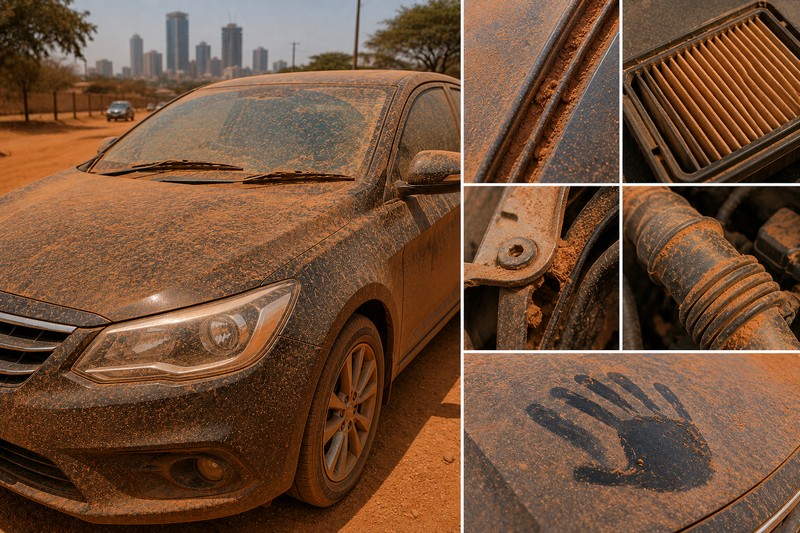
What Kenya's Red Dust Actually Is
Kenya's iconic red dust is laterite — a soil type formed by intense weathering of rock under hot, humid conditions over millions of years. It consists primarily of iron oxides (which give it the distinctive red colour), aluminium oxides, and very fine clay particles. These characteristics make it both visually distinctive and specifically damaging to vehicles in several ways.
The key physical properties that make laterite dust damaging to vehicles are:
- Extremely fine particle size: Laterite dust particles are small enough to penetrate gaps that would stop coarser dust — including filter media that is not rated for fine particle filtration, door seal gaps, and electrical connector openings.
- Mild abrasiveness: The iron oxide and silica content makes laterite dust harder than many of the surfaces it contacts. When wiped across paint, glass or plastic, it acts like very fine sandpaper — scratching the surface repeatedly over time.
- Adhesion: Laterite dust is electrostatically attracted to surfaces and tends to cling even in moving air. It does not blow off easily and requires water washing to remove effectively.
- Hygroscopicity: The clay component of laterite absorbs moisture. In humid conditions it forms a paste that bonds even more firmly to surfaces and accelerates corrosion of metal components it contacts.
The areas of Kenya with the highest red dust exposure include Central Kenya (Thika, Murang'a, Kirinyaga), Machakos and Makueni counties, rural areas around Nairobi including Rongai, Ngong and Kitengela, and many upcountry routes throughout the country.
How It Damages Your Engine
Abrasive Wear When Dust Bypasses the Filter
The engine air filter is the primary defence against dust entering the engine's combustion chambers. When the filter is new and functioning correctly, it captures the vast majority of dust particles before they can reach the intake manifold and cylinders. The problem arises in two specific situations that are both common in Kenya.
The first is a clogged filter. A heavily clogged air filter creates significant negative pressure in the intake system as the engine struggles to draw air through the blocked media. This pressure difference can cause dust-laden air to be drawn in through gaps around filter housing seals, through hose connections that were never intended to be airtight, or through cracks in the intake ducting that are otherwise inconsequential. The fine laterite particles that make it past the filter are highly abrasive and cause premature wear on cylinder walls, piston rings and valve seats — damage that is permanent and cumulative.
The second is a damaged or incorrectly fitted filter. Many oil changes and filter services in Nairobi are performed quickly by roadside mechanics who may not seat the air filter housing correctly or check that the filter element is undamaged. A filter that is even slightly dislodged from its seating allows unfiltered air — carrying all the laterite dust — to bypass the filter entirely. The engine then ingests abrasive particles directly with every breath it takes.
After any garage service that involves opening the air filter housing — air filter replacement, throttle body cleaning, or any intake system work — check that the filter is correctly seated and the housing is properly closed before driving away. This takes 30 seconds and prevents potentially serious engine damage from a careless reassembly.
Oil Contamination
Engine oil circulates through the entire engine and eventually returns to the sump. Fine dust particles that enter the intake and survive combustion can end up in the oil — either directly or through the blow-by gases that the PCV system routes into the intake. Contaminated oil with abrasive particles becomes a grinding paste that attacks bearings, camshafts and cylinder walls with every rotation of the engine.
This is one of the reasons that oil change intervals should be shorter in Kenya than manufacturer recommendations — which are based on clean-air conditions. If your vehicle is driven on murram roads regularly, consider reducing your oil change interval to 5,000 km rather than the standard 7,500–10,000 km. The additional cost (Ksh 2,000–5,000 per extra change per year) is trivial compared to the cost of premature engine wear.
What It Does to Your Filters
Engine Air Filter
As discussed above, the engine air filter is the front line of defence against laterite dust. On vehicles driven exclusively on paved roads in Nairobi, the standard replacement interval of 30,000 km may be adequate. On vehicles that use murram roads even occasionally — any upcountry journey, any construction diversion, any visit to a Nairobi suburb with unpaved access roads — this interval is far too long.
A practical approach for Kenyan conditions is to inspect the air filter every 5,000 km during the dry season and every 10,000 km during the rainy season, and replace whenever it shows significant dust loading — regardless of mileage. The visual inspection takes 2 minutes: remove the filter, hold it up to light, and tap it against your hand. If a significant cloud of red dust falls out and the filter media is visibly red and clogged, replace it. Cost: Ksh 500–2,000.
Cabin Air Filter
The cabin filter protects the passenger compartment from dust entering through the ventilation system. In Nairobi's dry season, vehicles used on murram roads can load a cabin filter to the point of significant restriction within 5,000–8,000 km. The consequences are reduced airflow from the ventilation and AC system — making the AC seem less effective — and poor air quality inside the vehicle as the overloaded filter allows fine particles to pass through.
Replace the cabin filter every dry season at minimum, and more frequently if you drive on unpaved roads regularly. If you notice a dusty, earthy smell from the vents when the fan is running, the cabin filter is likely overloaded and needs immediate replacement. Cost: Ksh 500–1,500. Find a garage for cabin filter replacement near you.
Fuel Filter
The fuel filter traps contaminants from the fuel before they reach the injectors or carburettor. In Kenya, contaminated fuel — particularly from smaller stations where storage tank seals may be compromised — combined with dust ingress during fuel cap opening and closing on dusty roads gradually loads the fuel filter. A clogged fuel filter restricts fuel flow, causing hard starting, rough running, reduced power and in severe cases engine stalling under load. Replace every 40,000 km or annually as part of a dry season service. Find a fuel system specialist near you.
Paint and Body Damage
Paint Scratching from Dry Wiping
The most common and most preventable paint damage from Kenyan red dust occurs during cleaning — specifically when dust is wiped off the paint surface with a dry cloth rather than rinsed off with water first. Each red laterite particle on the paint surface acts as a tiny abrasive particle when a cloth is drawn across it. A single dry wipe across a dust-covered panel creates hundreds of fine scratches. Repeated over weeks and months of dry season dust, this produces the characteristic dull, scratched appearance that many Kenyan vehicles develop despite appearing to be regularly cleaned.
The rule is absolute: always rinse dust off with water before any physical contact with the paint surface. A garden hose, a bucket of water or a proper car wash rinse — anything that removes the abrasive particles before wiping — prevents this damage entirely. Roadside car cleaners who dry-wipe your vehicle are damaging your paint, regardless of how gently they do it. Always insist on a water wash first.
Paint Fading from Combined UV and Dust
Red dust on paint acts as a UV trap — the iron oxide particles absorb and concentrate UV radiation at the paint surface. Combined with Kenya's intense equatorial UV, dust-covered paint fades significantly faster than clean paint. The difference between a regularly washed and waxed vehicle and one that sits dusty for extended periods during the dry season becomes visible within a single season as colour depth and gloss on the neglected vehicle diminishes noticeably.
Applying a quality car wax or paint sealant at the start of each dry season provides a sacrificial UV-protective layer between the paint and the dust-intensified UV. The wax itself may fade and be removed by repeated washing, but the paint beneath is protected. Find a detailing specialist for professional paint protection.
Underbody and Seal Corrosion
Laterite dust that accumulates on the underbody — particularly in areas that trap moisture, such as structural box sections, suspension mounting points and around exhaust brackets — combines with water during the rains or even morning dew to form a mildly corrosive paste. This paste attacks underbody coatings, causes corrosion at bolt heads and suspension component mounting points, and seizes exhaust heat shield fixings and brackets.
Rinsing the underbody at a car wash after any muddy or dusty driving removes the accumulated laterite before it can combine with moisture. Annual underbody inspection — particularly before the rainy season — identifies corrosion at suspension mounting points and other critical structural areas before it becomes structural damage.
Brakes and Suspension
Brake Disc and Pad Wear
Fine laterite dust that settles on brake discs and pads between brake applications acts as a mild abrasive in the braking interface. While the braking action itself clears most accumulated dust from the contact surfaces, fine particles that become embedded in the pad friction material or trapped in surface irregularities of the disc continue to abrade both surfaces. The effect is a measurably accelerated wear rate — brake pads and discs on vehicles regularly used on murram roads in Kenya wear faster than those on vehicles used exclusively on paved roads, requiring more frequent inspection and replacement.
After extended driving on dusty unpaved roads, gentle braking application several times on the first section of paved road clears accumulated dust from the brake surfaces. Book a brake inspection at the end of each dry season to assess wear before the rains, when brake effectiveness is most critical.
Suspension Bushing Degradation
Rubber suspension bushings are particularly vulnerable to laterite dust penetration. Fine dust particles work into the rubber-to-metal interface of each bushing, acting as an abrasive that gradually degrades the rubber surface. Combined with the UV and ozone degradation that Kenya's climate promotes, bushings on vehicles regularly driven on unpaved roads deteriorate significantly faster than those on vehicles used exclusively on paved roads.
This is one of the primary reasons that polyurethane replacement bushings are worth specifying in Kenya when worn rubber bushings are replaced — polyurethane is significantly more resistant to both dust abrasion and UV/ozone degradation than standard rubber. Find a suspension specialist for bushing inspection and replacement.
Seals and Electrical Components
Door and Window Seals
The rubber seals around doors and windows prevent dust from entering the passenger compartment. During the dry season on dusty Kenyan roads, these seals work continuously against a sustained dust load. Fine laterite particles work into the seal rubber and gradually abrade it, particularly where the seal contacts the door frame on closing. Over time, the seals develop gaps and flattened sections that allow dust to enter the cabin even with the windows closed.
Applying a rubber conditioner or silicone spray to door and window seals every 3 months during the dry season keeps the rubber supple and maintains the seal's effectiveness. Dry, cracked seals that are no longer sealing effectively cost Ksh 1,000–4,000 per door to replace — cheap, but avoidable with basic maintenance.
Electrical Connectors
Modern vehicles have hundreds of electrical connectors throughout the car — under the bonnet, under the vehicle, and throughout the interior. Fine laterite dust is small enough to penetrate electrical connector seals that are not rated for dusty environments. Once inside a connector, the dust combines with moisture to form a conductive paste that causes short circuits, or an insulating paste that causes open circuits. Both manifest as intermittent electrical faults that are notoriously difficult and expensive to diagnose.
Keeping electrical connectors clean and applying dielectric grease to exposed connectors during the dry season prevents dust ingress. Any electrical fault that develops gradually during the dry season and clears after rain — which washes away the conductive dust — is likely a connector contamination issue. An auto electrical specialist can identify and clean affected connectors.
Complete Prevention Guide
Daily and Weekly Habits
- Always rinse with water before any wiping contact with paint. This single habit prevents the paint scratching that ruins the appearance of more Kenyan vehicles than any other cause. Never allow a dry wipe on a dusty vehicle.
- Wash the car at least weekly during dusty dry season driving. Allowing dust to accumulate for extended periods gives it time to bond and combine with UV to damage the paint more severely.
- Close windows when driving on dusty unpaved roads. The fan on recirculation mode provides cabin air without drawing in the dust cloud you are generating. Open windows after reaching paved road.
- Park away from unpaved areas where possible. Even stationary vehicles accumulate dust blown by wind across nearby unpaved ground.
Monthly Checks
- Inspect the engine air filter. Remove and tap — if red dust falls in quantity and the filter media appears significantly discoloured, replace it regardless of mileage.
- Rinse the radiator and condenser. A gentle garden hose from behind clears accumulated dust from the fins and restores cooling and AC efficiency. Do this after any significant murram road driving.
- Check door and window seals. Look for gaps, flattening or cracking. Apply rubber conditioner if the seals look dry or brittle.
- Rinse the underbody. Most Nairobi car washes will rinse the underbody for a small additional charge. This removes accumulating laterite paste from structural sections and suspension components.
Every Dry Season
- Replace the cabin air filter. Even if airflow feels adequate, a new cabin filter at the start of each dry season ensures effective filtration throughout the season.
- Apply wax or paint sealant. Provides UV protection and makes subsequent washing easier — dust bonds less firmly to a waxed surface. Find a detailing specialist for professional application.
- Service the brakes. Have brake pads and disc condition assessed at the end of the dry season before the rains arrive. Worn brakes going into the rainy season are a serious safety risk.
- Have suspension bushings inspected. Dust-accelerated bushing wear is cumulative — catching deterioration early allows proactive replacement before bushings fail completely.
- Flush engine oil. If you have driven extensively on murram roads, consider a slightly earlier oil change to flush out any accumulated dust contamination. Find a service specialist near you.
Repair and Protection Costs in Kenya (2025)
| Item / Repair | Est. Cost (Ksh) | Priority | Notes |
|---|---|---|---|
| Engine air filter replacement | 500 – 2,000 | High | Inspect monthly — most critical protection item |
| Cabin air filter replacement | 500 – 1,500 | High | Replace every dry season minimum |
| Car wash (water rinse + soap) | 200 – 600 | Weekly | Never dry wipe — always water first |
| Wax / paint sealant (DIY) | 500 – 1,500 | Seasonal | Apply at start of each dry season |
| Professional detail and wax | 2,000 – 8,000 | Low | Every 3–4 months for best paint protection |
| Rubber seal conditioner | 300 – 800 | Low | Apply to door seals every 3 months |
| Oil change (shorter interval) | 2,000 – 5,000 | Medium | Every 5,000 km if on murram roads regularly |
| Brake inspection and service | 500 – 10,000 | Medium | End of dry season before rains arrive |
| Suspension bushing replacement | 1,500 – 8,000 | Medium | Polyurethane bushes resist dust better than rubber |
| Paint scratch correction | 3,000 – 15,000 | Restorative | Machine polish removes dry-wipe scratches |
Find a Mechanic to Service Your Car
Search 400+ verified garages across Nairobi and Kenya on FixMyCar. Protect your car from Kenya's red dust with a proper dry season service.
Find a Garage Now →Free to search · No booking fees · 400+ garages listed