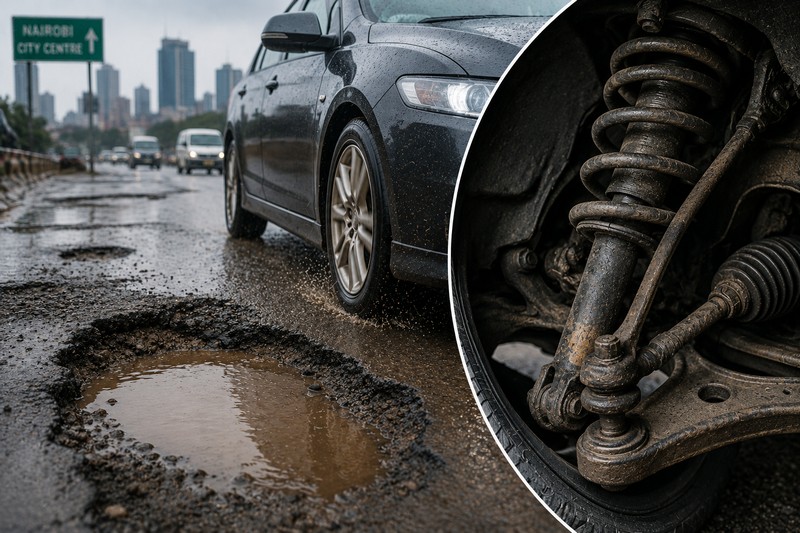
The Physics of a Pothole Impact
To understand why Nairobi's potholes are so damaging, it helps to understand what actually happens when your wheel hits one. When a tyre drops into a pothole, the wheel falls rapidly downward — then hits the far edge of the pothole as the car moves forward. This impact is transmitted directly up through the tyre, wheel rim and suspension components to the car body.
The force of this impact depends on two things: the depth of the pothole and the speed of the vehicle. The relationship is not linear — it is closer to exponential. A pothole hit at 60 km/h generates roughly four times the impact force of the same pothole hit at 30 km/h. This is why the standard advice to slow down for potholes is not just a matter of comfort — it is the single most effective way to protect your suspension.
At highway speeds on roads like Mombasa Road or the Nairobi–Nakuru highway, a deep pothole impact can generate forces of 5–10 times the normal wheel load. No suspension component is designed to absorb this indefinitely — repeated impacts accumulate damage that eventually causes failure.
Which Components Get Damaged Most
1. Wheel Rims and Tyres — First Point of Contact
The tyre and wheel rim absorb the initial impact before any suspension component. A deep pothole at speed can cause immediate, visible damage — a bent or cracked alloy rim, a tyre bulge where the internal structure has been damaged, or a sidewall cut. These are the most immediately visible consequences of a pothole strike and the reason you should visually inspect all four tyres and rims after any significant impact on Nairobi's roads.
Tyre bulges are particularly dangerous because they represent internal structural failure — the affected tyre is at risk of sudden blowout under load. A tyre that develops a bulge after a pothole strike must be replaced immediately — continued driving risks a blowout at speed. Bent rims cause vibration and can allow slow air loss from around the bead. Rim repair costs Ksh 2,000–5,000 for straightening; replacement costs Ksh 5,000–20,000 depending on size and type.
2. Shock Absorbers and Struts — Working Too Hard
The primary job of shock absorbers is to control the movement of the springs after a bump — they dampen the oscillation and keep the tyre in contact with the road. A normal shock absorber is designed for a lifetime of moderate bumps. Nairobi's potholes subject shocks to extreme extension and compression events — far beyond what gradual road undulations produce — and this dramatically accelerates wear.
A shock absorber on a Nairobi vehicle may reach its effective service life in 50,000–70,000 km rather than the 80,000–120,000 km a manufacturer might estimate for European conditions. The problem is insidious — shock absorber wear is gradual, and many drivers adapt to the increasingly floaty, imprecise feel of a car with worn shocks without realising how much handling has deteriorated. By the time the wear is obvious, the shocks have been operating ineffectively for a long time — accelerating wear on every other suspension component they connect to.
Shock absorber replacement in Nairobi costs Ksh 4,000–15,000 per unit. Always replace in axle pairs. Find a suspension specialist near you.
3. Ball Joints — The Most Safety-Critical Component
Ball joints are the pivot points that connect the suspension arms to the steering knuckle. They are engineered to handle the normal forces of driving — gradual cornering loads, gentle bumps, and the weight of the vehicle. What they are not designed for is repeated severe impact loads from deep pothole strikes at speed.
In Kenya, ball joint wear is accelerated by three compounding factors: the impact forces from potholes, the additional stress from the poor roads that cause continuous micro-vibrations even outside of pothole impacts, and the common absence of regular suspension inspection that would catch wear before it becomes critical. A ball joint on a Nairobi vehicle may need replacement at 60,000–80,000 km rather than the 100,000–150,000 km typical on smoother road networks.
The danger of worn ball joints cannot be overstated. A ball joint that fails completely — which can happen suddenly after one pothole impact too many on an already worn joint — causes the front wheel to collapse inward. At any speed, this results in immediate and total loss of steering control. Ball joint inspection is a non-negotiable part of vehicle maintenance in Kenya. Replacement costs Ksh 3,000–12,000 per joint.
Unlike most suspension components that provide warning signs before failure, a ball joint can fail suddenly on a single pothole impact. If a mechanic has told you that your ball joints are worn, replace them immediately — do not wait until your next service or until they start making a noise. This is one repair that cannot be safely deferred in Kenya's conditions.
4. Tie Rod Ends — Affecting Steering Precision
Tie rod ends transmit steering inputs from the steering rack to the front wheels. Each pothole impact sends a lateral shock through the tie rod ends — over thousands of impacts, the ball and socket joint within them develops play. When tie rod ends have significant wear, the steering feels vague and imprecise, the car wanders on straight roads, and tyre wear becomes uneven — typically wearing more on one edge than the other.
In Kenya, tie rod end wear is visible in the tyre wear pattern of many vehicles — the inside or outside edge of a front tyre significantly more worn than the rest of the tread. This pattern should prompt immediate inspection of tie rod ends and wheel alignment. Tie rod end replacement costs Ksh 2,500–8,000 per end. Wheel alignment must always be performed after replacement to restore correct steering geometry.
5. Coil Springs — Breaking Under Repeated Stress
Coil spring breakage is one of the most common suspension failures in Kenya — yet one of the most frequently undiagnosed. A coil spring is designed to flex and recover millions of times over its service life. However, the extreme compression events from deep pothole impacts create stress concentrations in the spring coil — particularly at the lower coil where it contacts the spring perch. Over time, these stress concentrations cause metal fatigue that eventually leads to the coil cracking and breaking.
A broken coil spring is not always obvious from inside the car. The symptoms are subtle — the car sitting slightly lower on one corner, a new thumping sound from that corner over bumps, and a slightly harsher ride on one side. Many Kenyan drivers continue driving with a broken spring for months without realising it. Inspection by a mechanic with the car on a ramp identifies broken springs immediately. Spring replacement costs Ksh 5,000–15,000 per axle and springs should always be replaced in pairs.
6. Suspension Bushings — Crumbling from Impact and Heat
Suspension bushings are rubber components at every pivot point of the suspension — control arm pivots, sway bar mounts, subframe mounts and strut mounts. Rubber has two enemies in Kenya: heat and impact loading. The equatorial heat of Kenya ages rubber faster than in temperate climates, making it brittle. Pothole impacts then crack and crumble the already-aged rubber.
Worn bushings produce creaking and rattling sounds, cause imprecise handling, and accelerate wear on the metal components they are meant to protect by allowing excessive movement at pivot points. Polyurethane replacement bushings are available in Nairobi and resist both heat and impact significantly better than standard rubber — worth specifying when replacing worn bushings on a vehicle that will continue to be driven on Kenyan roads. Bushing sets cost Ksh 1,500–8,000 per location.
7. Wheel Bearings — Worn by Lateral Impact Loads
Wheel bearings allow the wheels to spin with minimal friction. They are designed to handle the radial load of the vehicle's weight and the thrust loads of cornering. What pothole impacts add is severe axial and radial shock loading — every time the wheel drops into a pothole and impacts the far edge, a significant shock is transmitted through the bearing.
In Kenya, wheel bearing service life is significantly shorter than manufacturer estimates. A bearing that might last 150,000 km on smooth European roads may need replacement at 70,000–100,000 km in Nairobi conditions. The warning signs are a humming or growling that changes pitch when you weave left and right at highway speed, and vibration through the steering wheel that is not resolved by wheel balancing. Wheel bearing replacement costs Ksh 4,000–15,000 per wheel.
Signs Your Suspension Has Pothole Damage
After any significant pothole impact — or after an extended period of driving on rough Nairobi roads — check for these warning signs. Catching damage early prevents secondary damage to connected components.
- Visible tyre bulge on the sidewall — inspect immediately after any significant impact. Replace the tyre before driving further if found.
- Steering pulling to one side after an impact — a bent wheel, damaged tyre or wheel alignment disturbance from the impact.
- New clunking or knocking from a specific corner — ball joint, tie rod end or spring damage at that corner.
- Car sitting lower on one side — broken coil spring on the lower side.
- Vibration through the steering wheel at specific speeds — bent wheel rim causing imbalance.
- Handling that feels different or less precise than before — alignment disturbance, tie rod damage or ball joint play.
- Steering wheel not centred when driving straight — wheel alignment affected by the impact.
Any time you hit a significant pothole at speed — the kind that causes an audible bang and a jolt through the car — pull over safely at the next opportunity and visually check all four tyres for bulges. If the car feels different afterwards — pulling, vibrating or making new noises — have it inspected before your next long journey. A Ksh 1,000 inspection fee is far cheaper than the consequences of a failed component at highway speed.
Nairobi's Most Damaging Roads for Suspensions
Some Nairobi routes are particularly hard on suspension components — either because of the road surface itself, the density of speed bumps, or the combination of both. If you regularly use these routes, increase your suspension inspection frequency accordingly.
- Eastlands routes — Jogoo Road, Outer Ring Road, Kangundo Road: High density of potholes and poorly maintained surfaces. Suspension damage rates among the highest in Nairobi.
- Ngong Road and Karen areas: Combination of speed bumps, rough junctions and increasingly heavy traffic. Particularly hard on lower suspension components.
- Industrial Area roads: Heavy truck traffic breaks up road surfaces rapidly. Particularly hard on shock absorbers and wheel bearings.
- Mombasa Road near airport: Rough surface near the airport junction — many suspension failures reported on this section particularly after rainy season deterioration.
- Thika Road off-ramps and junctions: The main carriageway is relatively smooth but the junctions and access roads are rough. Many impacts occur pulling off the superhighway.
- Any murram diversion during road construction: Common throughout Nairobi and its outskirts — murram roads with no grading destroy suspension bushings and coil springs within weeks of regular use.
Repair Costs in Kenya (2025)
| Component / Repair | Est. Cost (Ksh) | Urgency | Notes |
|---|---|---|---|
| Wheel alignment (4-wheel) | 2,500 – 4,500 | Medium | Do after any significant pothole impact |
| Wheel balancing (per wheel) | 300 – 600 | Low | Do after any pothole impact that causes vibration |
| Rim straightening | 2,000 – 5,000 | Medium | Only viable if damage is not too severe |
| Tyre replacement (per tyre) | 4,000 – 15,000 | Urgent | Replace immediately if bulge is found |
| Ball joint replacement (per joint) | 3,000 – 12,000 | Urgent | Safety-critical — do not defer |
| Tie rod end replacement | 2,500 – 8,000 | Medium | Always do alignment after replacement |
| Shock absorber replacement (per unit) | 4,000 – 15,000 | Medium | Replace in axle pairs |
| Coil spring replacement (per axle) | 5,000 – 15,000 | Urgent | Replace in pairs — check after hard impacts |
| Wheel bearing replacement | 4,000 – 15,000 | Urgent | Do not delay — can seize without warning |
| Suspension bushing set | 1,500 – 8,000 | Medium | Polyurethane bushes last longer in Kenya |
How to Reduce Pothole Damage in Nairobi
- Slow down significantly before potholes and speed bumps. This is the single most effective protection for your suspension. Reducing from 60 to 30 km/h before a pothole reduces impact force by approximately 75%. Every extra second of awareness of road surface ahead saves significant money in suspension repairs.
- Maintain correct tyre pressure. Properly inflated tyres provide a cushioning effect that partially absorbs pothole impacts before they reach the suspension. An underinflated tyre provides less cushioning and is also at higher risk of rim damage and tyre failure on impact. Check pressure monthly — when cold.
- Have suspension inspected every 20,000 km. In Kenya's conditions this is the correct interval — not the manufacturer's 40,000–60,000 km recommendation based on smooth road use. Early detection of worn ball joints, tie rods and shock absorbers prevents the secondary damage that follows component failure.
- Inspect tyres and rims after any hard pothole impact. Pull over safely at the next opportunity and visually check for bulges and rim damage. A tyre bulge that is caught and replaced costs Ksh 4,000–15,000. A blowout at highway speed is a road accident.
- Do wheel alignment every 20,000 km and after significant impacts. Pothole impacts disturb wheel alignment even when no component is visibly damaged. Regular alignment checks prevent the uneven tyre wear that results from sustained misalignment and ensure the car handles predictably. Find a tyre and suspension specialist near you.
- Use polyurethane bushings when replacing worn ones. Standard rubber bushings deteriorate faster in Kenya's heat and under repeated pothole impacts. Polyurethane replacements resist both significantly better and last meaningfully longer — worth the slightly higher cost on a vehicle used daily on Nairobi roads.
- Avoid overloading your vehicle. Overloading increases the static load on every suspension component and multiplies the impact force from pothole strikes. Stay within the vehicle's rated payload — the sticker on the driver's door frame shows the maximum.
Get Your Suspension Checked Today
Search 400+ verified suspension specialists and garages across Nairobi and Kenya on FixMyCar. Catch pothole damage early before it becomes a safety issue.
Find a Specialist Near You →Free to search · No booking fees · 400+ garages listed