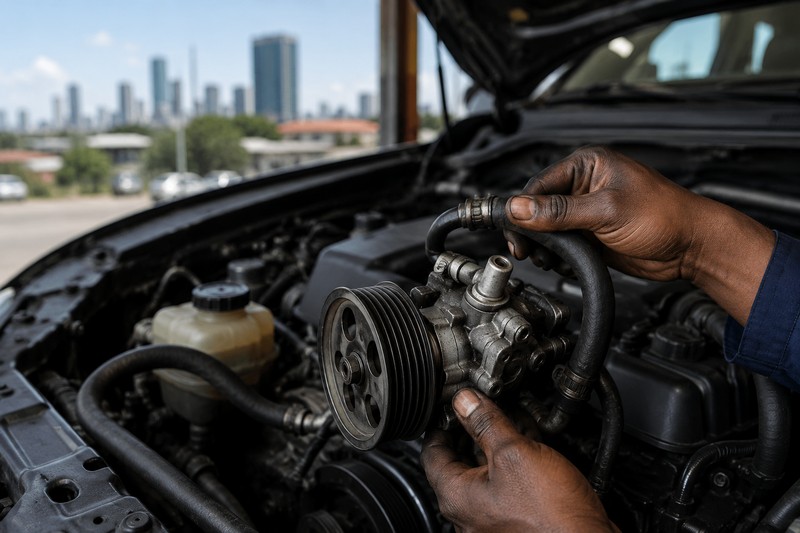
Hydraulic vs Electric Power Steering
Before diagnosing a power steering problem, it helps to know which type your vehicle has — the causes and repair approaches are completely different.
- Hydraulic power steering (HPS): Uses a belt-driven pump to pressurise power steering fluid, which assists the steering rack. Has a fluid reservoir under the bonnet, typically with a yellow or black cap with a steering wheel symbol. Most vehicles in Kenya built before 2010 have hydraulic systems. Problems include low fluid, leaking hoses, a failing pump and a worn steering rack.
- Electric power steering (EPS): Uses an electric motor to assist steering — no fluid, no pump, no belt. Found on most vehicles built after 2010, including Toyota Vitz, Mazda Demio, newer Subaru models and most modern vehicles. Problems are electrical — a failing motor, a faulty torque sensor, or an ECU fault. Often indicated by an EPS warning light on the dashboard.
If your car has no power steering fluid reservoir under the bonnet, it has electric power steering. The repair approach is completely different — check for an EPS warning light and have the system scanned with a diagnostic tool before any other diagnosis.
Warning Signs of Power Steering Failure
Power steering problems rarely appear without warning. These are the early signs to watch for — catching them early is the difference between a Ksh 2,000 fluid top-up and a Ksh 40,000 pump replacement.
| Warning Sign | Likely Cause | Urgency |
|---|---|---|
| Steering feels heavier than usual | Low fluid, weak pump or EPS fault | Check this week |
| Whining or groaning when turning | Low fluid or failing pump | Check fluid today |
| Steering stiff only when cold | Low fluid or old thick fluid | Service soon |
| Fluid puddle under front of car | Power steering fluid leak | Fix immediately |
| EPS warning light on dashboard | Electric power steering fault | Diagnose today |
| Steering suddenly very heavy | Pump failed or belt broken | Stop — unsafe to drive |
| Jerky or inconsistent steering assist | EPS motor or torque sensor fault | Diagnose urgently |
6 Most Common Causes in Kenya
1. Low Power Steering Fluid
The most common and cheapest cause of power steering problems on hydraulic systems in Kenya is low fluid level. The power steering fluid reservoir is a small translucent or opaque tank under the bonnet — usually near the front of the engine bay — with MIN and MAX markings. When the level drops through a slow leak, the pump draws air into the system along with the remaining fluid, causing the characteristic whining sound when turning and a heavy, inconsistent steering feel.
Check your power steering fluid level immediately if you notice any steering heaviness or whining. If it is low, top up with the correct fluid type — most vehicles use ATF (automatic transmission fluid) or a specific power steering fluid specified in the owner's manual. Never use brake fluid or engine oil as a substitute. A fluid top-up costs Ksh 200–600. A persistently low level means there is a leak that must be found and repaired — simply topping up repeatedly without fixing the source will lead to pump damage from running on insufficient fluid.
Locate the power steering reservoir — look for a cap with a steering wheel symbol, usually near the front of the engine bay. Check the level against the MIN and MAX marks. The fluid should be clear to slightly yellow-tinged. Dark brown or black fluid that smells burnt has degraded and should be flushed and replaced rather than just topped up.
2. Power Steering Fluid Leak
Power steering leaks are common in Kenya on older vehicles and are caused by deteriorating hose connections, cracked high-pressure hoses, or a leaking steering rack seal. The power steering system operates at significant pressure — particularly during parking manoeuvres and low-speed turning — which stresses hose connections and seals over time. Kenya's heat accelerates rubber degradation, making hose failures more frequent than in cooler climates.
Signs of a power steering leak include a reddish or clear oily fluid puddle under the front of the car, oily residue around hose connections in the engine bay, and a fluid level that drops regularly. High-pressure hose leaks are often visible as an oily mist sprayed around the engine bay near the pump. Power steering hose replacement costs Ksh 3,000–12,000 depending on which hose and the vehicle. Steering rack seal replacement is more involved — Ksh 8,000–25,000.
3. Failing Power Steering Pump
The power steering pump is belt-driven and creates the hydraulic pressure that assists steering. When the pump begins to fail — through wear, contaminated fluid or a bearing failure — it cannot maintain sufficient pressure, causing heavy steering that is most pronounced at low speeds and during parking. The pump typically announces its failure with a whining or moaning noise that increases when the steering wheel is turned towards full lock, and may also cause the steering to feel jerky or inconsistent.
Power steering pump failure is more common in Kenya on high-mileage vehicles and those where the fluid has never been changed or where the pump has been run on a low fluid level — running a pump with insufficient fluid generates significant heat and accelerates internal wear dramatically. Power steering pump replacement in Nairobi costs Ksh 8,000–30,000 depending on the vehicle, with reconditioned pumps available for most common Japanese models at significantly lower cost than new units.
4. Worn or Leaking Steering Rack
The steering rack translates the rotation of the steering wheel into the left-right movement of the front wheels. On hydraulic systems, the rack contains internal seals that can wear or crack over time — causing fluid to leak internally and reducing the hydraulic assistance available. A worn steering rack produces heavy steering, fluid leaks from the rack boots (the rubber sleeves at each end of the rack), a feeling of looseness or vagueness in the steering, and sometimes a clunking noise when turning.
Steering rack problems are more common on vehicles with high mileage and on those that have been driven on Kenya's rough roads without the wheel alignment being maintained — misalignment puts uneven loads on the rack seals and accelerates wear. Steering rack replacement is a significant repair in Nairobi — Ksh 20,000–70,000 depending on the vehicle and whether a reconditioned or new rack is used. Find a suspension specialist experienced with steering system repairs.
5. Power Steering Belt Failure
On hydraulic power steering systems, the pump is driven by a belt — either a dedicated V-belt or as part of the main serpentine belt. If this belt wears out, slips or snaps, the power steering pump stops receiving drive immediately and the steering becomes very heavy without warning. This is one of the most alarming sudden power steering failures because the change from assisted to unassisted steering is immediate and dramatic.
A slipping or worn belt typically announces itself with a squealing sound from the engine bay before it fails completely — particularly on cold starts or when the steering is turned to full lock under load. Belt inspection and replacement is inexpensive — Ksh 1,500–5,000 — and should be done proactively as part of the regular service schedule. If the belt snaps at highway speed on Mombasa Road or the Nairobi-Nakuru highway, the sudden steering effort change is genuinely dangerous. Find an engine specialist to inspect the belt condition.
6. Electric Power Steering (EPS) Fault
On vehicles with electric power steering — the majority of cars built after 2010 — a different set of failure modes applies. The most common EPS problems in Kenya are a failing EPS motor, a faulty torque sensor, a low vehicle battery causing insufficient voltage to the EPS system, or an EPS control unit (ECU) fault. These faults typically illuminate an EPS warning light on the dashboard — a steering wheel symbol, sometimes with an exclamation mark — alongside the steering becoming heavy or providing inconsistent assistance.
EPS problems are very common in Kenya when the car battery is weak or the alternator is failing — the EPS motor requires a stable voltage supply to operate correctly. Before assuming an expensive EPS motor or sensor failure, have the battery and charging system tested first. A weak battery is a Ksh 4,000–12,000 fix; an EPS motor replacement is Ksh 15,000–50,000. A diagnostic scan (Ksh 500–2,000) at a garage with EPS diagnostic capability reads the specific fault code and guides the repair correctly. Find an electrical specialist with EPS experience.
How to Diagnose the Problem
-
Identify your steering type — hydraulic or electricLook under the bonnet for a power steering fluid reservoir (steering wheel symbol on cap). If it exists, you have hydraulic power steering. If there is no reservoir and no fluid, you have electric power steering. The diagnosis path is completely different for each.
-
For hydraulic: check fluid level and condition immediatelyCheck the reservoir level — below MIN means low fluid, which is the most common and cheapest cause of power steering problems. Also check the fluid colour and smell — dark brown, burnt-smelling fluid needs a full flush and replacement, not just a top-up.
-
For electric: check the EPS warning light and batteryAn EPS warning light means the system has detected a fault and stored a code. Have the battery and alternator tested first — EPS problems caused by low voltage are resolved simply. Then have the EPS system scanned with a diagnostic tool to read the specific fault code.
-
Listen and feel for the specific symptom patternHeavy only at low speed = fluid or pump. Whining when turning = low fluid or pump. Stiff only when cold = old fluid. Sudden complete loss = belt failure. Intermittent and jerky = EPS motor or sensor. Heavy with EPS light = EPS fault. The pattern identifies the component directly.
-
Have a specialist inspect the full systemPower steering diagnosis beyond fluid checks requires specialist knowledge and equipment. Find a trusted suspension and steering specialist on fixmycar.ke for a full system inspection and accurate quote.
Repair Costs in Kenya (2025)
Hydraulic power steering repairs are generally more affordable in Kenya than EPS repairs due to wider parts availability and simpler repair procedures for the most common Japanese vehicles.
| Repair / Service | Est. Cost (Ksh) | Severity | Notes |
|---|---|---|---|
| Power steering fluid top-up | 200 – 600 | Low | Fix the leak — do not just top up repeatedly |
| Power steering fluid flush | 1,500 – 3,500 | Low | Do every 60,000–80,000 km or when fluid is dark |
| Power steering belt replacement | 1,500 – 5,000 | Medium | Proactive replacement prevents sudden failure |
| Power steering hose replacement | 3,000 – 12,000 | Medium | High-pressure hose is more expensive than return hose |
| Power steering pump replacement | 8,000 – 30,000 | High | Reconditioned units available for most Japanese models |
| Steering rack replacement | 20,000 – 70,000 | High | Always do wheel alignment after rack replacement |
| EPS diagnostic scan | 500 – 2,000 | First Step | Essential first step for electric power steering faults |
| EPS motor replacement | 15,000 – 50,000 | High | Test battery and alternator first — may not be needed |
Prevention Tips
- Check power steering fluid monthly on hydraulic systems. Takes 30 seconds. A level that drops indicates a leak — find and fix it before the pump runs dry. Running a power steering pump with insufficient fluid destroys it within weeks.
- Flush and replace power steering fluid every 60,000–80,000 km. Old, degraded power steering fluid loses its lubricating properties and causes increased wear on pump internals and rack seals. A flush and refill costs Ksh 1,500–3,500 and significantly extends system life. Use the fluid type specified in your owner's manual. Book a fluid service if yours has not been changed.
- Do not hold the steering at full lock under load. Turning the wheel to full lock and holding it there — while trying to manoeuvre in a tight Nairobi parking space — puts maximum pressure on the pump and rack seals. This is one of the leading causes of power steering pump failure and should be minimised.
- Have the power steering belt inspected at every service. A glazed, cracked or fraying belt is a sudden failure waiting to happen. A mechanic can check it in 30 seconds with the bonnet open — ask for it to be included at every service. Proactive replacement costs a fraction of the inconvenience of sudden steering heaviness at speed.
- Keep your battery and charging system in good condition for EPS vehicles. Electric power steering requires stable voltage to function correctly. An annual battery and alternator test (free or Ksh 200–500 at most garages) prevents EPS faults caused by voltage instability — saving the cost of unnecessary EPS component replacement.
- Maintain correct wheel alignment. Misalignment puts uneven loads on the steering rack and pump — accelerating wear on both. Have alignment checked every 20,000 km or after any suspension work. Find a tyre and suspension specialist near you.
Find a Steering Specialist Near You
Search 400+ verified garages and steering specialists across Nairobi and Kenya on FixMyCar. Get your power steering diagnosed and fixed properly.
Find a Specialist Near You →Free to search · No booking fees · 400+ garages listed