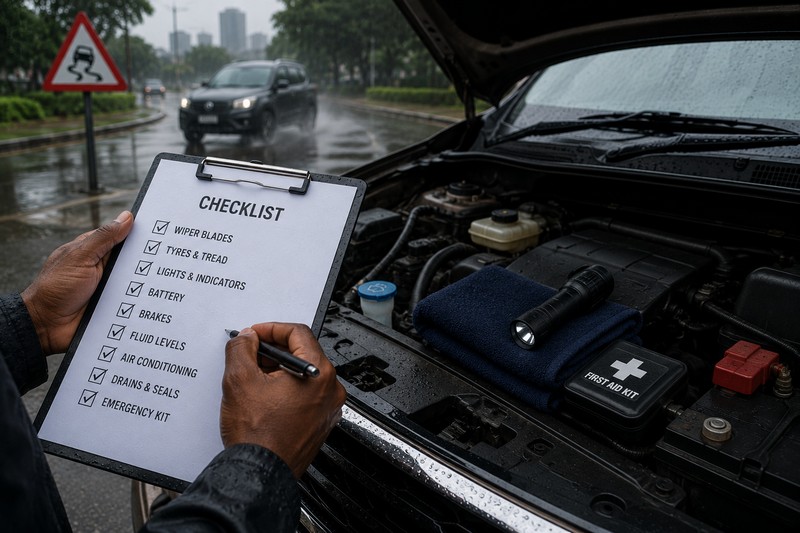
Why the Rains Are Hard on Kenyan Cars
Kenya's long rains create a unique combination of hazards that are significantly more damaging to vehicles than ordinary wet weather. Understanding why helps you prioritise the right preparations.
- Nairobi floods fast and deep. The city's drainage infrastructure cannot keep pace with heavy rainfall. Roads that are passable in the morning can have 60cm of standing water by the afternoon. Flooded roads hide potholes, debris, and road edges — making every drive a navigation challenge.
- Potholes multiply dramatically. Kenyan road surfaces absorb water, the substrate weakens, and traffic breaks through the surface — creating new potholes overnight. A road you drove confidently yesterday may have several new hazards today.
- Visibility drops significantly. Heavy rain, spray from other vehicles and a fogged windscreen combine to reduce visibility to a fraction of normal. Worn wiper blades and a defective defroster become genuinely dangerous rather than merely inconvenient.
- Moisture attacks electrical systems. Water ingress through worn seals, a cracked windscreen or a damaged door seal can cause electrical faults, corrosion in connectors, and safety system failures.
- Corrosion accelerates. The combination of moisture and mud from Kenyan roads attacks underbody components, exhaust hangers, brake hardware and suspension fixings. A vehicle that was fine before the rains may develop rattles, corrosion and seized components during or after them.
Complete Pre-Rains Checklist
Work through this checklist at least two weeks before the rains begin — giving yourself time to fix anything that needs attention. Book a pre-rains service at a trusted garage on fixmycar.ke and show them this list.
Visibility — Your Most Critical Safety Check
In heavy Nairobi rain, wiper blades that streak and tyres with worn tread are not just an inconvenience — they are genuinely life-threatening. These two items must be in perfect condition before the rains arrive. Everything else on this checklist is important; these two are critical.
- Wiper blades: Replace if they are more than 12 months old, streak across the screen, chatter, or leave unwiped patches. In Kenya's UV conditions, wiper rubber degrades faster than in temperate climates. Test both front blades at maximum speed in heavy simulated rain — they should clear the screen completely on every sweep. Rear wiper if fitted should also be tested. Replacement costs Ksh 500–2,000 per pair.
- Windscreen washer: Fill the reservoir and test that jets spray correctly onto the screen. Clean blocked jets with a pin. Check the pump works — a silent pump when the stalk is operated means the pump motor has failed (Ksh 1,500–3,500 to replace).
- Windscreen condition: Any crack in the driver's direct line of vision must be repaired or the screen replaced before the rains. A crack that is stable in dry weather can propagate rapidly with temperature changes from rain hitting a hot screen. Chips can be repaired (Ksh 1,000–2,500); cracks in the vision zone require full replacement (Ksh 8,000–25,000).
- Interior demister / rear defog: In Kenya's highland areas — Karen, Gigiri, Lavington — cold rain causes immediate windscreen fogging. Test the AC in demist mode and the rear defogger (the heated lines on the rear screen). A non-functional rear defogger leaves you blind behind. Rear defogger repair costs Ksh 1,500–5,000.
- Headlights: Rain significantly reduces visibility — all lights must work perfectly. Check both headlights (low and high beam), front and rear indicators, brake lights, hazard lights and fog lights if fitted. Clean yellowed or foggy headlight lenses — polishing kits cost Ksh 500–1,500 and significantly improve light output in the rain.
Tyres — Your Only Contact With a Wet Road
- Tread depth: The legal minimum in Kenya is 1.6mm — but for wet road safety, 3mm should be your personal minimum before the rains. Tyre tread channels water away from the contact patch; worn tread cannot do this and aquaplaning — where the tyre floats on a film of water — becomes a serious risk. Check all four tyres and replace any below 3mm. Budget Ksh 4,000–15,000 per tyre.
- Tyre condition: Check all sidewalls for cracks, bulges and cuts. Kenyan roads during the rains hide potholes that cause sudden impacts — a bulged or cracked tyre is at much higher risk of blowout under such conditions. Replace any damaged tyre before the rains.
- Tyre pressure: Check and set to the manufacturer's specified pressure (on the sticker inside the driver's door). Correct pressure is critical for wet-road handling. Check pressure when the tyres are cold — before the first drive of the day.
- Spare tyre: Check the spare is inflated to the correct pressure and that the jack and wheel brace are in the vehicle. A breakdown in a Nairobi downpour with a flat spare is a particularly miserable experience.
Brakes — Essential for Wet Road Stopping
- Brake pad thickness: Wet roads increase stopping distances — worn brake pads make this worse. Have pads inspected before the rains and replace any axle below 4mm remaining. Find a brake specialist for inspection.
- Brake discs: Scored or warped discs reduce wet-road braking effectiveness significantly. Surface rust that forms on discs overnight is normal and clears after a few stops — but permanent scoring or warping must be addressed.
- Brake fluid: Old brake fluid absorbs moisture over time, lowering its boiling point. In the rains, brake fade from overheated fluid is a real risk after heavy use. Change brake fluid if it has not been changed in the last two years.
- Parking brake: Test that the handbrake holds on a slope — essential for the many hill starts you will make in flooded traffic diversions across Nairobi.
Cooling System — Overheating in Slow Traffic
- Coolant level: Check and top up if needed. The rains do not reduce overheating risk — Nairobi traffic is often slower during heavy rain as visibility drops and accidents multiply. A well-maintained cooling system is as important in the rains as in the dry season.
- Coolant condition: If the coolant has not been flushed in the last two years, do it before the rains — old coolant corrodes the cooling system internally and loses its heat-transfer efficiency. A flush costs Ksh 1,500–2,500. Find a fluid service specialist.
- Radiator and hoses: Inspect hoses for cracks and soft spots. Check the radiator for leaks around the top and bottom tanks. A hose that was marginal in the dry season may fail under the thermal cycling of rain-and-sun conditions.
Electrical System — Water and Electricity Don't Mix
- Battery terminals: Clean any corrosion from battery terminals and apply petroleum jelly. The rains dramatically accelerate terminal corrosion. A corroded terminal that barely manages to start the car in dry weather will fail in the damp mornings of the rainy season.
- Battery condition: Have your battery tested if it is over 2.5 years old. Cold, damp rainy season mornings demand more from the battery than warm dry weather. A battery that starts the car fine in October may struggle in April.
- Door and windscreen seals: Check rubber seals around all doors and the windscreen for cracks and gaps. Water ingress through failed seals damages electrical components, causes interior mould and can short circuit critical systems. Door seal replacement costs Ksh 1,000–4,000 per door.
- Underbonnet wiring: Check that wiring harnesses under the bonnet are properly clipped away from areas where water could pool. Any exposed or damaged wiring insulation should be repaired before the rains.
Underbody and Suspension
- Suspension inspection: Have a mechanic check ball joints, tie rod ends, shock absorbers and bushings before the rains. Flooded roads hide potholes — you will hit more unseen obstacles during the rainy season than at any other time. Components that are marginally worn in dry conditions fail under rainy season pothole impacts. Find a suspension specialist.
- Exhaust system: Check that exhaust hangers are intact and the exhaust is not dragging or close to the ground. Driving through flooded roads with a low exhaust can cause water to enter the system.
- Underbody protection: If your vehicle has an undertray, check it is fully secured. A partially detached undertray that drops into a flooded road can be torn off completely, leaving vulnerable components exposed.
- Ground clearance: Know your vehicle's ground clearance. For sedans and low-profile cars in Nairobi, avoid roads that visually appear to have water depth close to or above 20cm — the risk of water entering the air intake or damaging underbody components increases significantly above this depth.
Emergency Kit — Essential for the Rains
- Serviceable spare tyre, jack and wheel brace — a flat tyre in a Nairobi downpour is miserable without these.
- Warning triangles — two, legally required in Kenya and essential visibility in low-visibility rain conditions.
- Torch and waterproof jacket in the boot.
- Jump-start cables or a portable jump-starter pack — damp conditions and repeated short trips drain batteries.
- Phone charger or power bank — you may need navigation and emergency calls more than usual during the rains.
- A saved contact for a trusted mechanic from fixmycar.ke — before you need one in the rain.
Driving Tips During the Rains
- Slow down — significantly. Wet roads increase stopping distances by 50–100% compared to dry conditions. If you normally follow at 2 seconds in dry weather, maintain at least 4 seconds in rain.
- Switch on headlights in rain — even during the day. Kenyan law requires lights to be on when visibility is reduced by rain. It also makes you dramatically more visible to other drivers, matatu drivers and pedestrians in poor visibility.
- Avoid flooded roads whenever possible. If you cannot see the road surface, you cannot know the depth. A puddle that looks 10cm deep may be 50cm — enough to stall a car, damage the engine and trap occupants. Take longer alternative routes rather than risking a flood crossing.
- Drive through shallow floods slowly and continuously. If you must cross shallow standing water, use first gear at slow walking pace — around 5 km/h. Keep the engine revving slightly higher than idle to prevent water from entering the exhaust. Never stop in flooded water.
- Test your brakes after driving through water. Water on the brake discs temporarily reduces braking effectiveness. After crossing standing water, apply the brakes gently several times to generate heat that dries the disc surface. Do this on a clear stretch of road before needing to brake in an emergency.
- Watch for new potholes every day. Roads that were smooth yesterday may have new hazards today after a night of heavy rain. Reduce speed on sections you are less familiar with during the rainy season.
What to Do If You Drive Through a Flood
-
Do not restart the engine if it stalls in waterIf your engine stalls in flood water, do not attempt to restart it. Water may have entered the air intake and reached the cylinders. Attempting to crank a water-filled engine causes hydraulic lock — the incompressible water bends or breaks connecting rods instantly, destroying the engine. Get out safely and call for assistance.
-
Get all occupants out safely if water is risingIf the water level around the car is rising, exit the vehicle immediately. Open the door before the water reaches door height — once the water is above the bottom of the door, the pressure makes it very difficult to open. Move to higher ground away from the flood.
-
Have the car inspected before restarting after a deep floodIf the car was submerged to any significant depth, have a mechanic inspect it before attempting to start. Check the air filter for water — if it is wet, water may have reached the engine. Check the oil dipstick — if it shows a milky or frothy oil level, water has entered the engine and it must not be started.
-
Check for water in electrical componentsAfter flood exposure, check for water in the headlights, tail lights and any electrical connectors that may have been submerged. Allow the car to dry thoroughly before testing electrical systems. Find a trusted mechanic on fixmycar.ke for a post-flood inspection.
Pre-Rains Service Costs in Kenya (2025)
| Service / Item | Est. Cost (Ksh) | Priority | Notes |
|---|---|---|---|
| Wiper blade replacement (pair) | 500 – 2,000 | Critical | Non-negotiable before the rains |
| Tyre replacement (per tyre) | 4,000 – 15,000 | Critical | Replace any tyre below 3mm tread |
| Brake inspection & pad replacement | 3,000 – 10,000 | Urgent | Wet roads demand full brake effectiveness |
| Coolant flush and refill | 1,500 – 2,500 | Medium | If not done in last 2 years |
| Battery test and replacement | Free – 12,000 | Medium | Test is free — replace if over 2.5 years old |
| Windscreen chip repair | 1,000 – 2,500 | Medium | Fix chips before rain causes them to crack |
| Windscreen replacement | 8,000 – 25,000 | Urgent | Any crack in driver's vision zone |
| Suspension pre-rains inspection | 1,000 – 3,000 | Medium | Identifies worn components before pothole impacts |
| Door seal replacement (per door) | 1,000 – 4,000 | Medium | Prevents water ingress and electrical damage |
| Headlight lens polishing | 500 – 1,500 | Low | Significantly improves night and rain visibility |
Book Your Pre-Rains Service Today
Search 400+ verified garages across Nairobi and Kenya on FixMyCar. Get your car properly prepared before the long rains arrive.
Find a Garage Now →Free to search · No booking fees · 400+ garages listed