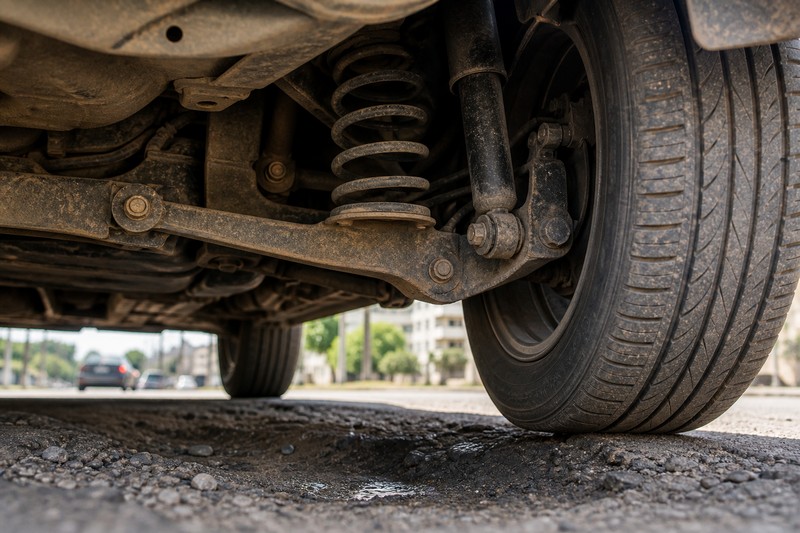
What Each Noise Means
The type and timing of a suspension noise is the most important diagnostic clue. Note carefully when the noise occurs and what it sounds like before visiting a garage — it saves significant time and money.
- Clunking or knocking over bumps and potholes: Worn ball joints, worn tie rod ends, broken or worn shock absorber top mounts, or loose suspension components. Very common on Nairobi roads.
- Creaking or groaning when turning or going over slow bumps: Dry or worn suspension bushings, worn sway bar end links, or a dry strut bearing. Usually not immediately dangerous but worsens over time.
- Rattling over rough surfaces: Loose heat shield, loose exhaust bracket, worn anti-roll bar links, or a loose suspension component. Can sound alarming but is often a minor fix.
- Thumping from one corner over bumps: A broken coil spring — very common in Kenya. The spring coil can break and the broken end thuds against the spring perch or body with every bump.
- Squeaking over bumps — front or rear: Dry or worn suspension bushings, dry coil spring isolators, or worn strut top mounts needing lubrication or replacement.
- Noise when braking combined with suspension noise: Worn strut top mounts or loose caliper hardware — the braking force reveals play in components that are quiet during normal driving.
7 Most Common Causes
1. Worn Shock Absorbers or Struts
Shock absorbers and struts control the movement of the suspension after a bump — they dampen the spring's natural oscillation and keep the tyre in contact with the road. When shocks wear out — which happens within 60,000–80,000 km in Kenya's conditions, significantly faster than the manufacturer's typical estimates — they lose their damping ability. The suspension bounces more freely over bumps, handling becomes vague and floaty, and the car takes longer to settle after a pothole.
Worn shocks do not always produce a dramatic noise at first. The most common symptoms are excessive body bounce after going over a bump (press down on each corner of the car — it should bounce once and stop, not continue bouncing), a nose-diving sensation under braking, and the car feeling unsettled and difficult to control on rough surfaces like the roads around Eastlands or on the approach to Ngong.
Shock absorber replacement in Nairobi costs Ksh 4,000–15,000 per unit depending on the vehicle and quality of the replacement. Always replace shocks in axle pairs — both fronts or both rears — to maintain balanced handling. Find a suspension specialist near you.
2. Worn Ball Joints
Ball joints connect the suspension arms to the steering knuckle and allow simultaneous steering and suspension movement. They are under constant load on Kenya's rough roads and wear significantly faster than the manufacturer's schedule anticipates. Worn ball joints produce a clunking or knocking noise over bumps and rough surfaces — the characteristic sound is a dull clunk from the front suspension when hitting a pothole or negotiating an unmarked speed bump.
As mentioned in our guide on tyre and suspension services, worn ball joints are one of the most safety-critical suspension components. A ball joint that fails completely causes the front wheel to collapse — leading to immediate loss of steering control. If you hear clunking from the front suspension over bumps, have the ball joints inspected without delay. Ball joint replacement costs Ksh 3,000–12,000 per joint in Nairobi.
Jack up the front of the car safely and grasp the tyre at the 12 o'clock and 6 o'clock positions. Try to rock it in and out — any movement indicates a worn wheel bearing or lower ball joint. Then grasp at 9 and 3 o'clock and rock — movement here indicates a worn tie rod end or upper ball joint. Any play in these checks warrants immediate professional inspection.
3. Worn or Collapsed Suspension Bushings
Suspension bushings are rubber or polyurethane cushions at the pivot points of control arms, sway bars and subframe mounts. They absorb road shocks and allow controlled suspension movement. In Kenya, bushings deteriorate faster than the manufacturer's schedule because of the combination of equatorial heat (which ages rubber quickly), constant impact loads from potholes, and the general age of the vehicle fleet.
Worn bushings produce creaking, groaning or knocking sounds — particularly when the suspension moves slowly, such as when pulling into a driveway, going over a speed bump at low speed, or when the car body rolls during cornering. They also cause vague, imprecise handling and increased road noise generally. Bushing replacement costs Ksh 1,500–8,000 per set depending on location and vehicle. Polyurethane replacement bushings last significantly longer than standard rubber ones in Kenyan conditions and are worth the premium.
4. Broken Coil Spring
Coil spring breakage is extremely common on Kenyan roads and is one of the most frequently missed diagnoses. The spring typically breaks at the lower coil — the part that sits on the spring perch — and the broken end can be very difficult to see without lifting the car and inspecting carefully. A broken spring produces a distinctive thumping sound from the affected corner, most noticeable over bumps. The car may also sit lower on the affected corner, and you may notice an increase in ride harshness on one side.
A broken coil spring is a safety issue — the broken end can puncture the tyre in some configurations, and the reduced spring rate affects handling significantly. Springs should always be replaced in axle pairs (both front or both rear) to maintain balanced ride height and handling. Spring replacement in Nairobi costs Ksh 5,000–15,000 per axle depending on the vehicle.
5. Worn Anti-Roll Bar Links and Bushings
The anti-roll bar (sway bar) connects the left and right suspension on each axle to reduce body roll during cornering. It connects to the suspension through end links — small rods with ball joints or rubber bushings at each end — and to the body through bushings. Both the end links and the bushings wear relatively quickly on Kenya's roads, producing a rattling or clunking noise specifically when the suspension moves unevenly between left and right — most noticeable on Nairobi's uneven surfaces and when going over a bump on one side only.
Anti-roll bar link replacement is one of the most straightforward suspension repairs — the links are small and accessible, and replacement costs Ksh 2,000–6,000 per axle. Anti-roll bar bushing replacement costs Ksh 1,000–3,000. These are often identified during a routine suspension inspection.
6. Worn Strut Top Mounts and Bearings
The strut top mount connects the top of the front strut to the vehicle body and contains a bearing that allows the strut to rotate when you turn the steering wheel. When the mount's rubber element wears or cracks, or when the bearing wears out, it produces a clunking or knocking sound when going over bumps, a creaking sound when turning the steering wheel at low speed, and sometimes a grinding or clicking feeling through the steering wheel over rough surfaces.
Strut top mount problems are very common in Kenya on vehicles that frequently negotiate the deep speed bumps found on residential roads in areas like Langata, Kileleshwa and Kilimani. The deep bumps put extreme shock loads through the top of the strut on every crossing. Strut top mount replacement costs Ksh 3,000–10,000 per side and is typically done at the same time as a shock absorber replacement since both are accessed during the same operation.
7. Loose or Broken Exhaust Heat Shields
This is worth mentioning specifically because it is extremely common in Kenya and produces a rattling sound that is very easily mistaken for a suspension problem. The exhaust system has several heat shields — thin metal plates that protect the chassis, floor and fuel tank from exhaust heat. These shields are attached with simple clips and bolts that corrode and loosen over time, particularly after driving through flooded streets during the rainy season.
A loose heat shield produces a metallic rattling sound that changes character with road speed and surface texture, disappears when you press firmly on the exhaust pipe area, and is often worse after the exhaust has heated up. Many drivers spend Ksh 5,000+ on suspension inspections only to find a loose heat shield clip is the entire cause of the rattle. A mechanic can tighten or remove a loose shield in 15 minutes for Ksh 200–1,000.
How to Diagnose the Problem
-
Identify which corner the noise comes fromFront left, front right, rear left, rear right? Drive slowly over a known bump and listen carefully. Have a passenger listen while you drive — a second pair of ears narrows down the location much faster. The corner the noise comes from tells the mechanic exactly where to start the inspection.
-
Note when the noise occursOnly over large bumps or potholes? (Ball joints, broken spring, shock top mount.) Over all rough surfaces including small bumps? (Worn bushings, anti-roll bar links.) When turning slowly? (Strut bearing, dry bushings.) When braking? (Strut top mount or loose brake hardware.) The timing is as important as the sound.
-
Do the bounce test on each cornerPush down firmly on each corner of the car and release. The car should bounce once and stop. If it continues to bounce 2–3 times, the shock absorber on that corner has lost its damping ability and needs replacement.
-
Check for a visibly lower cornerStep back and look at the car from the front and rear. If one corner sits noticeably lower than the opposite side, a broken coil spring is likely. This is sometimes very obvious — a 30–50mm height difference — and sometimes subtle. Check with a tape measure from the wheel arch to the ground on each side.
-
Have suspension fully inspected by a specialistA full suspension inspection requires the car to be lifted and each component physically checked for play, wear and damage. Find a trusted suspension specialist on fixmycar.ke — most will inspect and provide a written quote at minimal cost.
Repair Costs in Kenya (2025)
Suspension repair costs in Kenya vary widely by vehicle — Japanese vehicles like Toyota and Subaru have the lowest parts costs due to wide availability. European vehicles cost significantly more for equivalent parts.
| Repair / Service | Est. Cost (Ksh) | Urgency | Notes |
|---|---|---|---|
| Shock absorber replacement (per unit) | 4,000 – 15,000 | Medium | Replace in axle pairs — never just one side |
| Ball joint replacement (per joint) | 3,000 – 12,000 | Urgent | Safety-critical — do not delay if worn |
| Suspension bushing replacement | 1,500 – 8,000 | Medium | Polyurethane bushes last longer in Kenya |
| Coil spring replacement (per axle) | 5,000 – 15,000 | Urgent | Replace in pairs — always both fronts or both rears |
| Anti-roll bar links (per axle) | 2,000 – 6,000 | Medium | Very common and straightforward repair in Kenya |
| Strut top mount replacement | 3,000 – 10,000 | Medium | Do at the same time as shock absorber replacement |
| Heat shield repair / tightening | 200 – 1,500 | Low | Often mistaken for a suspension problem — check first |
| Full suspension inspection | 1,000 – 3,000 | First Step | Always start here before authorising repairs |
Prevention Tips for Kenyan Roads
- Slow down significantly for potholes and speed bumps. The impact force on suspension components when hitting a pothole at 80 km/h is enormous. Reducing to 20–30 km/h before an obstacle dramatically extends component life. This single habit is the most effective suspension protection on Kenyan roads.
- Have suspension inspected every 20,000 km. Ask your mechanic to specifically check ball joints, shock absorbers, bushings, springs and anti-roll bar links at every major service — not just when you hear a noise. Early detection of wear prevents the more expensive failures that follow.
- Replace shocks in axle pairs. When one shock is worn on an axle, the other has usually experienced the same load and mileage. Replacing both maintains balanced handling and saves a second labour charge within a few months.
- Consider polyurethane bushings when replacing worn ones. Standard rubber bushings deteriorate faster in Kenya's heat and rough road conditions. Polyurethane alternatives from local suppliers cost slightly more but last significantly longer — a worthwhile investment on a vehicle you plan to keep.
- Do wheel alignment after any suspension repair. Replacing ball joints, bushings, springs or shock absorbers affects the suspension geometry. Always follow up with a four-wheel alignment (Ksh 2,500–4,500) to restore correct tyre wear and handling.
- Avoid overloading your vehicle. Many Kenyan vehicles are regularly overloaded with passengers and cargo. Overloading compresses springs beyond their design limit, accelerates bushing wear, and increases pothole impact loads on ball joints and shock absorbers. Stay within the vehicle's stated load capacity.
Find a Suspension Specialist Near You
Search verified suspension and tyre specialists across Nairobi and Kenya on FixMyCar. Get your suspension inspected properly before small wear becomes a safety issue.
Find a Specialist Near You →Free to search · No booking fees · 400+ garages listed