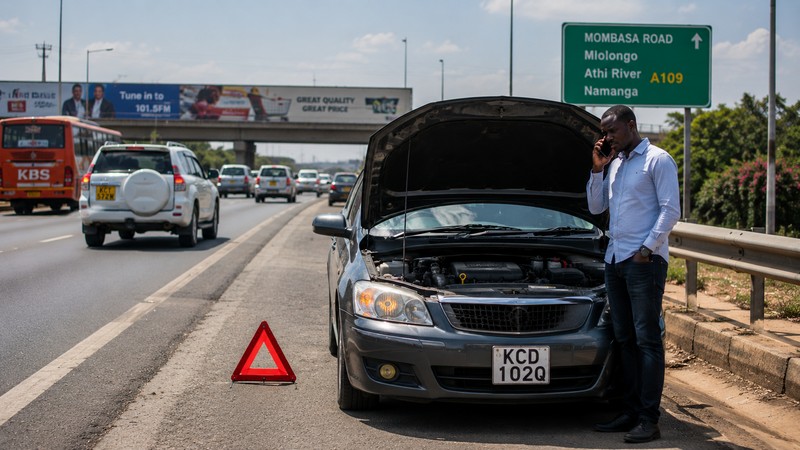
Immediate Steps: The First 5 Minutes
The actions you take in the first five minutes of a breakdown determine how safe the situation is for you, your passengers and other road users. Follow these steps in order — do not skip ahead.
-
Indicate left and move off the road immediatelyThe moment you sense something is wrong — a strange noise, sudden loss of power, a warning light, or a tyre blowout — indicate left and look for the nearest exit. A service road, petrol station forecourt, or even a wide dirt shoulder is far safer than the carriageway. Get as far off the road as possible before stopping.
-
Switch on your hazard lights immediatelyDo this even before you have fully stopped — as soon as you begin to slow down. Hazard lights warn approaching drivers from a significant distance. Keep them on for the entire time your vehicle is stopped on or near the road, even during daylight hours.
-
Place warning triangles behind the vehiclePlace your first triangle approximately 5 metres behind the car, and a second one at least 45–50 metres back. On a fast road like Mombasa Road, the rear triangle is essential — drivers travelling at 80 km/h need at least 45 metres of warning distance to react safely. Warning triangles are a legal requirement in Kenya and you can be fined for not carrying them.
-
Get all passengers out and well away from trafficMove everyone to the left side of the vehicle, as far from the road as possible. If there is a barrier, embankment, or ditch on the left, stand behind it. Never allow anyone to stand in the road, between the car and oncoming traffic, or directly behind the vehicle.
-
Assess the situation before attempting any repairsOnly attempt a repair — such as changing a tyre — if you are completely off the carriageway, on stable flat ground, and it is safe to do so. For anything else, or if you are in any doubt about safety, call for help before opening the bonnet or going under the car near moving traffic.
Getting Help in Nairobi
Find a Verified Garage on FixMyCar
The fastest way to find a trusted mechanic or tow truck near your location on Mombasa Road is to search fixmycar.ke. Filter by your current area — Industrial Area, Mlolongo, Syokimau, Athi River — and find garages with verified reviews and direct contact numbers. Many garages along the Mombasa Road corridor offer roadside assistance and towing services.
Kenya Police Emergency
For a serious breakdown involving an accident, injuries, or a vehicle stuck in a dangerous position that cannot be moved, call the Kenya Police on 999 or the toll-free line 0800 722 203. Police can assist with managing traffic around your vehicle and coordinating emergency services if needed.
AA Kenya (Automobile Association)
If you are an AA Kenya member, their roadside assistance service covers towing, battery jump-starts, lockouts, tyre changes and minor on-road repairs. AA Kenya membership costs approximately Ksh 5,000–8,000 per year — worth considering if you drive frequently on major Kenyan highways.
Changing a Tyre Yourself
If your breakdown is a flat tyre and you are safely and completely off the road on flat stable ground, you can change it yourself if you have a serviceable spare, a jack and a wheel brace. On Mombasa Road specifically, only attempt this if no part of your vehicle or yourself is near a live lane. If there is any doubt about safety, wait for professional help — a tyre change is not worth risking your life.
Avoiding Roadside Scams on Mombasa Road
Mombasa Road is unfortunately known for opportunists who approach broken-down vehicles offering help — then charge vastly inflated prices, claim parts are damaged that are not, or in some cases attempt theft while you are distracted. Exercise real caution with any unsolicited approach.
- Do not accept help from anyone who approaches your vehicle unsolicited — particularly if they were not already working at a nearby visible garage or petrol station.
- Agree on a specific price before any work starts. Get it stated clearly in front of a witness, or in writing if possible. Vague agreements lead to inflated bills once the work is done.
- Do not allow anyone to take parts from your vehicle to go and source a replacement unless you physically accompany them or have a very clear agreement in writing about what will happen.
- Use garages found through FixMyCar or another verified platform rather than whoever happens to walk up to your window. Verified garages have reviews and accountability.
- If you feel unsafe at any point, get back into your locked vehicle with hazard lights on and call for help by phone rather than engaging further with strangers around your car.
How to Reduce Breakdown Risk on Mombasa Road
If you regularly use Mombasa Road — for airport runs, travel to the industrial area, or the long drive to the coast — these checks before every journey significantly reduce your breakdown risk.
- Check tyre pressure and condition weekly. Mombasa Road has rough sections near the airport and through Mlolongo that are hard on tyres. A blowout at highway speed is one of the most dangerous breakdown scenarios.
- Check engine coolant and oil levels monthly. The slow traffic near the airport junction and the Globe roundabout interchange is a known overheating zone. See our guide on car overheating in Nairobi traffic.
- Ensure your spare tyre is inflated and the jack is in the boot. Many drivers discover on the roadside that their spare is flat or the jack has been removed from the vehicle. Check both monthly.
- Keep your fuel tank above a quarter full at all times. Running out of fuel on Mombasa Road is dangerous and entirely avoidable.
- Service your car on schedule. Find a reliable garage near you on fixmycar.ke and book a service before you need emergency help on the road.
Breakdown Kit Checklist for Kenya
Every vehicle in Kenya should carry the following items at all times. Most cost very little and could save your life or a significant repair bill.
- Two warning triangles (legally required in Kenya)
- A serviceable spare tyre, jack and wheel brace — check the spare is inflated
- Jump-start cables or a portable battery jump-starter pack
- A torch — for safety visibility and for working after dark
- Basic toolkit: pliers, screwdrivers, adjustable spanner
- One litre of engine oil and one litre of coolant
- A high-visibility vest — recommended, especially for night breakdowns
- A basic first aid kit
- A phone charger or portable power bank
- A saved contact for a trusted mechanic or tow service from fixmycar.ke — find one before you need it
Find a Garage Before You Need One
Save the contact of a trusted mechanic near Mombasa Road right now — before a breakdown makes it urgent. Search 400+ verified garages on FixMyCar.
Find a Garage Near Mombasa Road →Free to search · No booking fees · 400+ garages listed